
‘There is no such thing as a global patent’
Jeffrey Saltman, partner at US intellectual property law firm Fisch Sigler LLP, recently spoke to pv magazine about the rising number of patent lawsuits between PV module manufacturers. He said this increase in litigation mainly stems from the industry’s convergence on tunnel oxide passivated contact (TOPCon) tech and noted that the number of lawsuits is likely to rise in the near future.

Controlling grid fluctuations via solar module cooling
A research group has proposed a novel method to control ramp rates in power networks. Its control optimization is based on weather, load and production forecast data. The scientists simulated the operation of the proposed technique and reached a ramp rate reduction of up to 76.2%.

Metrel launches electrical installation safety tester for PV systems
Metrel, a Slovenian measurement equipment supplier, says its new electrical installation safety tester can assess systems with a maximum voltage of up to 1,500 V and a maximum short circuit current of 40 A.
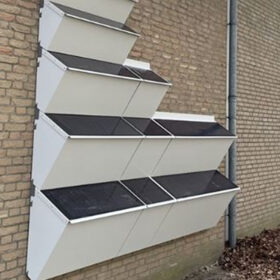
New design guidelines for integrated photovoltaics
A Belgian-Dutch research team has defined new design guidelines for photovoltaics integrated in buildings or infrastructures. The proposed approach, which was validated through two demonstators, supports the manufacturing of semi-fabricates for integrated photovoltaics applications by enabling effective communication between project developers and module producers.
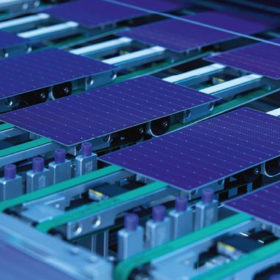
Huasun to supply 1 GW of HJT products to Xinjiang Silk Road, annually
The Chinese company said that, under a new agreement, it will collaborate with Xinjiang Silk Road to produce high-efficiency HJT PV modules. It will supply silicon wafers, cells, modules, and more.

First Solar warns global solar manufacturers of patent infringement
The U.S. solar panel manufacturer has sent letters to Longi, Trina Solar, Jinko Solar, JA Solar and Canadian Solar saying it believes the companies are infringing on its patents.

Chinese PV Industry Brief: Polysilicon prices steady amid demand issues
The China Nonferrous Metals Industry Association (CNMIA) says that prices for solar-grade polysilicon remain stable this week despite strong producer pricing intentions, as unresolved downstream demand issues are holding back sales potential.
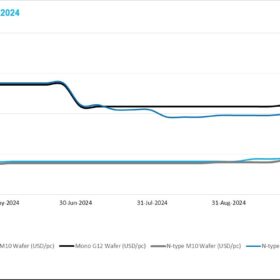
Wafer prices drop, inventory levels rebound despite operating rate cuts
In a new weekly update for pv magazine, OPIS, a Dow Jones company, provides a quick look at the main price trends in the global PV industry.
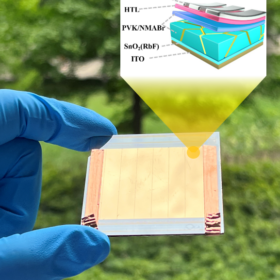
Perovskite solar cell based on lead iodide treated with 4-fluorobenzylamine achieves 23.62% efficiency
By regulating the secondary growth of lead iodide, an international group of scientists has built a perovskite solar cell with low non-radiative recombination and defect state density. The device reportedly exhibited superior stability in both humidity and thermal stability tests compared to reference cells.
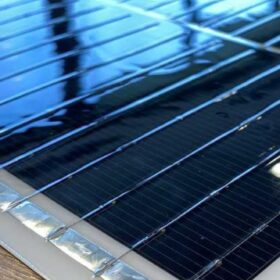
Softbank, Longi develop 665 g/m2 heterojunction solar modules with 22.2% efficiency
Researchers from the two companies have built a lightweight and flexible silicon heterojunction (HJT) PV panel that measures 563 mm x 584 mm and weighs just 218.5 g.
