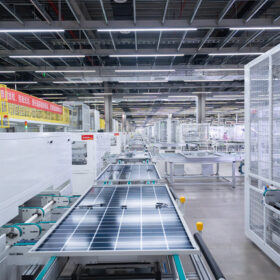
Tongwei to acquire Runergy
Tongwei has presented a CNY 5 billion ($698.9) million offer to acquire Chinese solar module maker Runergy. If successful, the transaction will be the largest M&A deal in the PV sector this year.
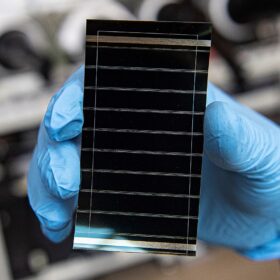
Making perovskite solar PV circular from the start
U.S researchers at the Department of Energy’s National Renewable Energy Laboratory used a circular economy framework to determine how to scale, deploy, and design metal halide perovskite solar panels to be easily recyclable in the future.

Chinese PV Industry Brief: CECEP Solar to build 500 MW project with desert tech
CECEP Solar says it will build a 500 MW PV project with desertification-control technology in Dalad Banner, Inner Mongolia, including 75 MW/150 MWh of battery storage.

US tariffs on solar cells remain, volume increases
The administration of US Presiden Joe Biden has issued a proclamation stating that the tariff rate quota of 14.25% on solar cells will remain, but the volume will increase from 5 GW to 12.5 GW.

Agrivoltaics for corn
Researchers have created a novel model that can help developers assess corn growth in agrivoltaic facilities. They also proposed to use spatiotemporal shadow distribution (SSD) to optimize crop yield and power production.
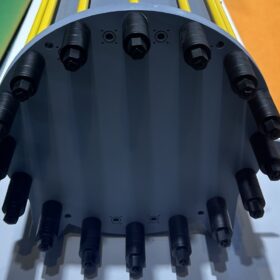
Offgrid PV-driven hydrogen vs. standalone solar-plus-storage
A German research team has compared the economic performance of an offgrid PV-electrolyser-fuel cell system with that of a standalone solar-plus-storage counterpart in a building in Niger. Its analysis showed that decentralized PV-driven hydrogen could achieve considerable lower levelized cost of energy and levelized cost of storage than the PV-battery system, with these values reaching €0.12 ($13.1)/kWh and €0.35/kWh, respectively.
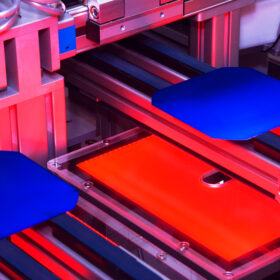
Ebon Solar announces plans for US solar cell factory
Ebon Solar says it will invest $942 million in a New Mexico solar cell factory, creating more than 900 jobs.

World’s highways could host 52.3 billion solar panels, say researchers
Researchers from the Chinese Academy of Sciences, Tsinghua University, Chinese Academy of Geosciences, and Columbia University have concluded that solar-covered highways could meet more than 60% of the world’s annual energy needs.

Next2Sun bets on Italy for market expansion
Despite difficulties in France, Next2Sun still sees growth opportunities in Europe, starting with Italy. The German agrivoltaics supplier tells pv magazine that it is also increasingly active in Japan.
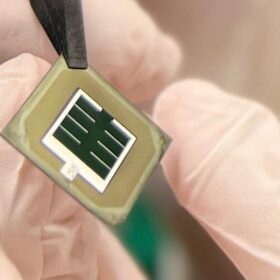
KAUST reveals details of 33.7%-efficient perovskite-silicon tandem solar cell
In a new scientific paper, researchers from the King Abdullah University of Science and Technology (KAUST) in Saudi Arabia presented the 33.7%-efficient perovskite-silicon tandem solar cell announced in May last year. They explained the device is based on a perovskite additive known as tetrahydrotriazinium that reportedly enhances the phase stability of the perovskite film under heat and light conditions.
