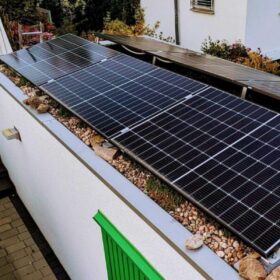
German startup offers plug-and-play 2.46 kW PV system
Wattando has developed a new rooftop PV solution that can be easily connected to a household’s power network via an AC connection. The system uses existing infrastructure and reportedly reduces installation work and time.
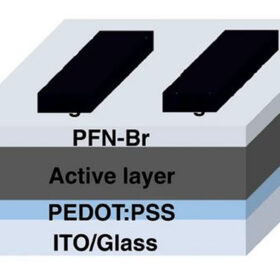
Organic solar cell based on trichlorobenzene achieves 19.31% efficiency
An international research team developed an organic solar cell based on a novel non-monotonic intermediated state manipulation strategy. The device reportedly showed non-radiative recombination losses while exhibiting remarkable power conversion efficiency.

Circular recycling approach aims for ‘perpetual utility’ of PV materials
After analyzing the future usage of material by the crystalline silicon PV industry, including glass, aluminum, silver, copper, ethylene-vinyl-acetate (EVA), and silicon, a German research team found that a circular recycling approach could address foreseeable supply problems. It could also reportedly become economically sustainable.

ABB launches smart panel for home energy management
ABB says it has launched a smart panel for home energy management in partnership with Lumin, featuring software to control solar, batteries, and electric-vehicle chargers.
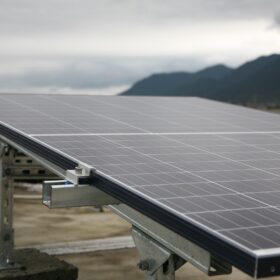
Low tilt angles ideal for regions with high summer load demand
New research from India shows the advantages of deploying fixed tilt PV systems with low angles in regions with high summer load demand like India. The scientists said that, although PV systems with low tilt angles may not achieve maximum power yield or the lowest levelized cost of energy (LCOE), they can reduce reliance on expensive grid electricity during high-demand periods.
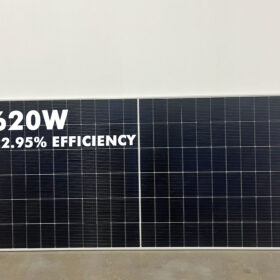
Leapton Energy debuts 600-625 W TOPCon solar panel based on rectangular wafers
Leapton says its new panels have a temperature coefficient of -0.30% per C and an efficiency of up to 23.14%. They come with a 30-year power output guarantee for 87.4% of the initial yield.
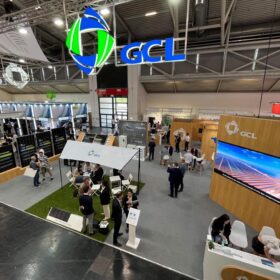
GCL Tech, Mubadala to open polysilicon factory in UAE
Chinese polysilicon maker GCL Tech says it is partnering with Emirati state-owned Mubadala Investment Co. to build the Middle East’s first polysilicon factory in the United Arab Emirates.

Researchers build 24.4%-efficient perovskite solar cells with room temperature process
Researchers from the U.S. and South Korea have developed a method to make high-quality perovskite films at room temperature. The film was tested in a conventional perovskite solar cell architecture and the result was a power conversion efficiency of exceeding 24%.

East-west rooftop solar ideal for energy communities under net metering
Researchers in Italy have investigated the potential of deploying energy communities based on east-west PV systems and have concluded that these projects, despite their lower energy yields compared to south-oriented installations, show higher shared energy values. They also warned, however, that the presence of a net metering scheme is crucial to make the east-west layout the preferred option.

Perovskite tandem PV integrator secures $4.7 million of US funds
The US Department of Energy (DoE) has provided Tandem PV with $4.7 million in funds to advance the commercialization of the company’s thin-film solar technology.
