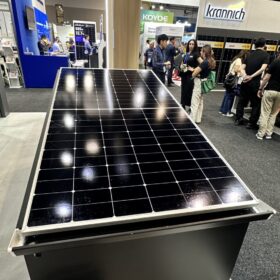
Longi launches anti-dust solar module for C&I segment
Chinese solar manufacturer Longi has developed a new “anti-dust” module for the commercial and industrial (C&I) market in Australia. The frame sits flush against the glass on the short side, allowing water to wash off.
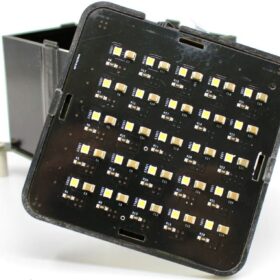
Lightricity unveils indoor PV testing products
UK-based Lightricity, a spinoff of Oxford-based Sharp Laboratories of Europe, has launched testing equipment for indoor PV devices that are small enough to power wristwatches to larger ones meant for electronics devices and internet-of-things (IoT) sensors.
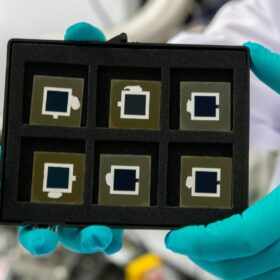
Perovskite-perovskite-silicon tandem solar cell achieves record-breaking efficiency of 27.1%
Researchers in Singapore have built a triple junction tandem solar cell with an ultrawide-bandgap perovskite absorber integrating cyanate (OCN) ions. The cell surpassed the power conversion efficiencies previously reported for all other perovskite-based triple-junction tandems, as well as single-junction perovskite and silicon solar cells.
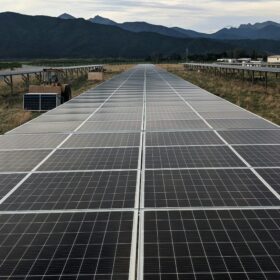
Chinese PV Industry Brief: Huaneng buys $0.12/W modules in 10 GW tender
Huaneng Group has selected eight manufacturers – JA Solar, JinkoSolar, Huayao PV, LONGi, Tongwei, GCL SI, Risen, and Huasun – for its latest PV module procurement exercise.

European Parliament, Council reach provisional agreement on forced labor
The European Parliament and European Council have reached a provisional agreement on forced labor, in order to ban products made with forced labor from the European Union, pending parliamentary approval. Member countries will have three years to enforce the new provisions.
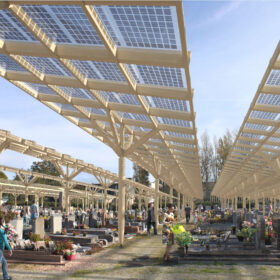
French energy associations installing solar shades above cemetery
Brier’energie and RECIT are installing solar shades above a cemetery in Saint-Joachim, northern France. The installation will span 8,000 square meters and is designed for self-consumption.
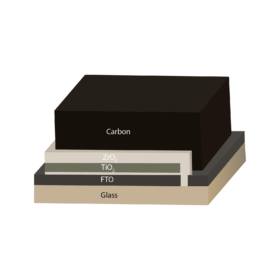
First attempt to build perovskite solar cell based on ionic liquids delivers 13.8% efficiency
North Korean researchers have designed a perovskite solar cell with an absorber treated with ionic liquids. The device reportedly offers improved passivation and fewer recombination losses.
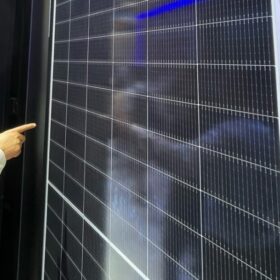
Italy offers fiscal breaks to PV projects built with EU-made solar modules
Italy’s new provisions state that fiscal credits can be awarded to PV project developers that use solar panels produced in the European Union with module efficiency ratings of more than 21.5%, or products with cell efficiencies above 23.5%. The fiscal credits will cover up to 35% of panel prices.
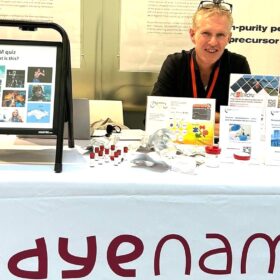
Dyenamo expands materials offer for perovskite-silicon tandem solar cells
In response to its customers’ needs, Sweden’s Dyenamo has added several new perovskite product lines and increased production of materials for the full range of perovskite solar cell designs.
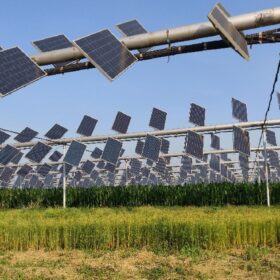
Vertical bifacial vs. stilted agrivoltaics
Scientists in Austria have conducted a life cycle assessement of vertical bifacial agrivoltaic systems and stilted agrivoltaic facilities. Their analysis revealed that vertical installations have lower environmental impacts in wide range of scenarios.
