
End-of-life management of solar PV waste in India
A new study proposes an ‘extended producer responsibility’ regulatory framework for end-of-life solar PV management in India.
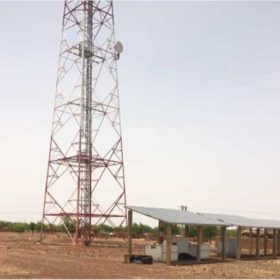
How PV performs close to radio, TV antennas
Researchers in Kenya have analyzed the performance of an off-grid PV system located near an isotropic antenna as an emitting source.

Lithuanian module maker says European and US clients moving away from Chinese supply chain
Vilnius-headquartered Solitek is preparing to ramp its output next year on the back of rising orders in Scandinavia, and says its new partnership with New York-based Convalt Energy will reduce its dependence on Asian semiconductors and solar cells.
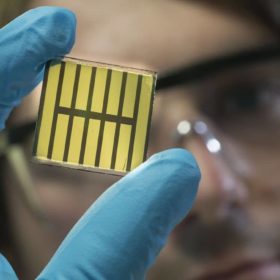
Established thin film processing for 18%-efficient perovskite mini-modules
Scientists in Germany applied vapor-based deposition techniques and laser scribed interconnection – both well established processes in existing thin-film solar manufacturing – to fabricate perovskite mini modules. The group achieved a maximum efficiency of 18% for a device measuring 4cm². Relying on these processes, they say, could simplify processing and reduce losses associated with scaling up to commercial-sized devices.
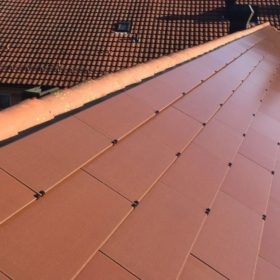
Solar tile with anti-glare coating from Switzerland
Swiss manufacturer Megasol said the new product is compatible with the most common tile formats and also available in different colors. Megasol has also developed a coating that eliminates the glare effect of solar modules.

Handheld dry-cleaning tool for solar modules
The handheld, cordless cleaning tool is a cost-effective and efficient alternative to automated cleaning robots that are usually limited in operation by panel inclination.

Storm damages shine spotlight on ways to mitigate impact of wind on PV arrays
Hurricane-force wind gusts hit New England during a late-October storm, damaging at least one rooftop solar array and leading Commercial Solar Guy to offer a few pointers.
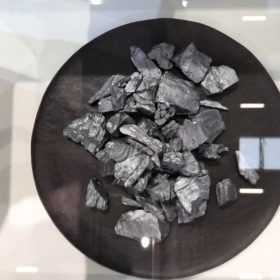
Chinese PV Industry Brief: TBEA wants to set up 400,000 MT metal silicon production
TBEA unveiled a plan to build a 400,000 MT metal silicon factory in Baotou City, in the Inner Mongolia province. Furthermore, EnergyTrend reported polysilicon prices increased slightly this week.
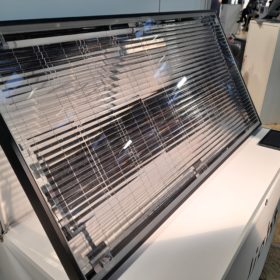
Insolight unveils 20.1%-efficient translucent photovoltaic panel for agrivoltaics
Insolight has developed a translucent monocrystalline solar panel with a nominal power of 106 W and a power conversion efficiency of 20.1%. The solar cells are covered with protective glass and optical lenses to concentrate and direct sunlight onto them at around 100 times the intensity of standard solar glass.
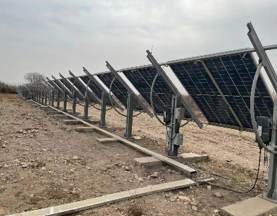
210mm wafer achieves highest energy yield, finds Trina Solar
Trina Solar has found that its Vertex modules, based on the 210mm wafer, achieve an energy yield up to 1.6% higher than rival products based on the smaller 182mm wafer format. The company conducted outdoor testing at two separate sites with varying climates, finding that products based on the larger format have a particular advantage in low-irradiance environments.
