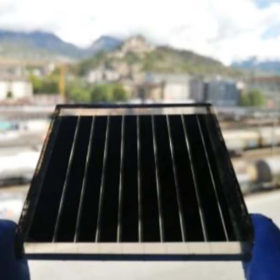
Isomer passivation for a 21.4% efficient perovskite module
An international team of scientists trialled a new approach to passivating defects in perovskite solar cells. Using a tailored arrangement of atoms, the team was able to overcome challenges related to the formation of a two-dimensional perovskite layer on top of the active cell material, and reach 21.4% conversion efficiency for a 26cm² active area, which they claim as a record for a perovskite device of this size.

Shipping problems for First Solar but production line expansion is under way
The U.S. manufacturer has started building its third Ohio production base and has also begun ordering equipment to kit out its first factory in India.

USA Roundtables 2021 live blog: Thank you for attending!
Join pv magazine and solar industry leaders as we meet for the USA Roundtables 2021 today, from 10:00 AM to 5:00 PM EST.

Chinese PV Industry Brief: Two major deals for PV production equipment
JSG has sold several ingot furnaces to Shuangliang Eco-Energy and Jinchen Machinery will provide Yingli with production equipment totaling 3.5 GW.

Gallium arsenide nanowire solar cell with 7.7% efficiency
Norwegian scientists have developed a gallium arsenide (GaAs) nanowire solar cell that can be used as a top cell in a dual tandem cell with a bottom silicon cell. The device is claimed to be the most efficient single-junction GaAs nanowire solar cell grown on a silicon substrate so far.
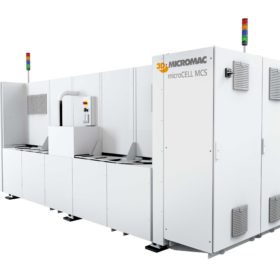
New laser-cutting system for half-cut, shingled PV cells
German manufacturer 3-D Micromac said it has developed a new machine that can produce more than 6,000 wafers per hour. It is suitable for solar cells with temperature-sensitive coatings, or depositions such as heterojunction devices.

End-of-life management of solar PV waste in India
A new study proposes an ‘extended producer responsibility’ regulatory framework for end-of-life solar PV management in India.
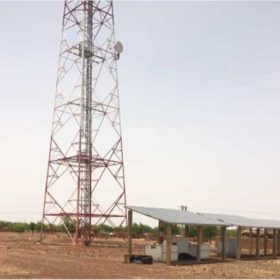
How PV performs close to radio, TV antennas
Researchers in Kenya have analyzed the performance of an off-grid PV system located near an isotropic antenna as an emitting source.
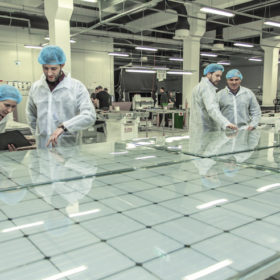
Lithuanian module maker says European and US clients moving away from Chinese supply chain
Vilnius-headquartered Solitek is preparing to ramp its output next year on the back of rising orders in Scandinavia, and says its new partnership with New York-based Convalt Energy will reduce its dependence on Asian semiconductors and solar cells.
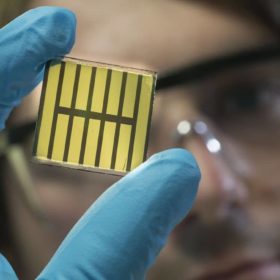
Established thin film processing for 18%-efficient perovskite mini-modules
Scientists in Germany applied vapor-based deposition techniques and laser scribed interconnection – both well established processes in existing thin-film solar manufacturing – to fabricate perovskite mini modules. The group achieved a maximum efficiency of 18% for a device measuring 4cm². Relying on these processes, they say, could simplify processing and reduce losses associated with scaling up to commercial-sized devices.
