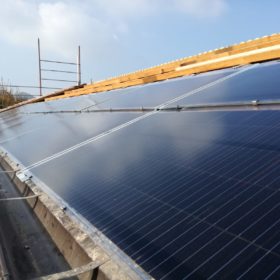
Solar tiles for roof coatings, shelters, facades
Italian startup EnergyGlass has developed a solar tile with 4 mm double-laminated safety glass. It is available in black, white and colored versions and has power outputs ranging from 120 W to 290 W. The tiles can be used to replace conventional roofs or they can be integrated into existing rooftops.

Perovskite solar pioneers honored with prestigious prize
The work undertaken separately by seven academics to discover the promise of perovskite materials for solar, and to open the door to high-efficiency devices, has been recognized by the judges of the Rank Prize for Optoelectronics.

French consortium develops bio-based PV modules
Roctool, a French production equipment supplier, has teamed up with the CEA-Liten research institute to develop 300 mm x 300 mm solar modules based on recycled, bio-based materials via a novel manufacturing process. The first prototypes will be unveiled over the next few months.

Doping delivers improved performance for perovskite solar cells
Some of the world’s largest solar PV module manufacturers are warning about looming panel shortages, but Australian researchers have declared that the industry is now drawing closer to a new generation of cheap, sustainable and efficient solar cells.

Intersolar Europe day 2: There’s still plenty of buzz here in Munich
Welcome back to the second day of Intersolar Europe! Stay tuned as the pv magazine team brings you the latest solar PV and energy storage news from day 2 of this year’s Intersolar Europe.
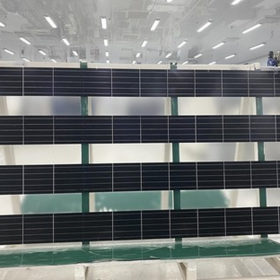
Vietnamese manufacturer unveils PV module for agrivoltaics
Vietnamese manufacturer Irex has announced a new glass-glass solar panel with a power output of 265 W and a power conversion efficiency of 18.1%.

PV modules expensive and scarce, no change in sight
Solar PV modules are currently trading at price levels last seen in 2018 and 2019, according to an account manager at PVO International. EPC companies in Europe, in particular, are suffering. A lack of large-scale integrated PV production on the continent is also playing a role.
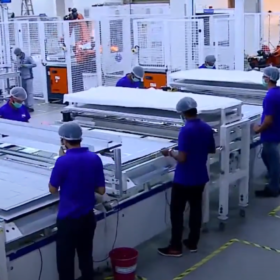
Emmvee sets up 3 GW solar cell and module factory in India
Planned to be located in Dobaspet, Karnataka, the manufacturing facility will be Emmvee’s second solar factory in the Indian State.

Intersolar Europe Day 1: Hope for Europe’s PV manufacturers
For the first time since 2019, Intersolar Europe has opened its doors. The pv magazine team is delighted to be on the ground in Munich this year to bring you the latest solar PV and energy storage developments, events, and trends from the event, as they happen. Stay tuned for our live updates over the next three days!
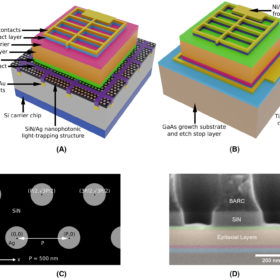
Ultrathin gallium-arsenide solar cell with light management architecture
Scientists led by Cambridge University fabricated an ‘ultrathin’ solar cell, just 80 nanometers thick, using gallium arsenide. The III-V cell achieved 9.08% conversion efficiency, and its developers have demonstrated in simulations that it could reach 16% with further optimization. Given its light weight and intrinsic resistance to radiation, the cell could be suitable to power satellites and other applications in space.
