
JinkoSolar, Longi, JA Solar claim 182mm modules offer lowest LCOE for utility scale solar
In a white paper, the three Chinese module manufacturers have reiterated the well-known refrain “bigger is not always better.” Experts from the three companies compared the BoS costs of 182mm-wafer-based modules and 210mm products, and found that the former have a slight advantage in racking, foundation, and land costs.
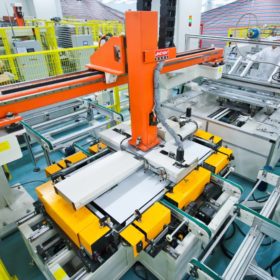
China’s Jinchen holds 10 GW of solar production line orders from India
Jinchen Machinery has landed module production equipment orders from leading Indian solar manufacturers. It has already installed 2 GW of production lines and plans to supply the balance within three months. The company will open an India office in Surat, in the state of Gujarat.

Roundtables Europe Video: Maintaining PV quality alongside rapid technological development
The adoption of new technology is required to grow and maintain PV’s place in the energy transition. Thankfully, the rate of change within PV technology is accelerating, pointing to a bright future. But what quality risks are emerging from these new technologies? And how can they be managed? Watch the first of four videos from our pv magazine Roundtables Europe event to find out.
The PV glass price rollercoaster
First-half profits will be up at solar panel glassmaker Xinyi Solar despite the fact the price of the module raw material has been on a downward trend in the current three-month window.

US Congress urges Border Patrol action on forced labor allegations
Members of the U.S. Congress have called on the Customs and Border Protection commissioner, Troy Miller, to take immediate action regarding polysilicon products entering the United States from Xinjiang, China.
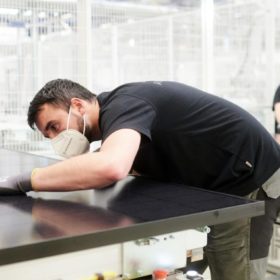
Meyer Burger wants to build another 400 MW factory
The Swiss manufacturer has secured €185 million for the expansion of its cell and module production. Meyer Burger no longer wants to sell its solar cells to third parties in the future.
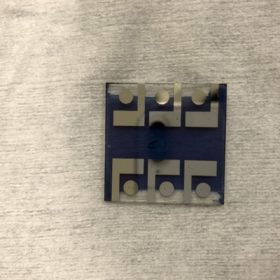
Organic solar cell with 18.4% efficiency via new electrode coating
Saudi scientists built the cell’s electrode with a hole-transporting molecule called Br-2PACz and not with the commonly used PEDOT:PSS. It helped improve the photovoltaic cell efficiency by around 0.9%.
Chinese PV Industry Brief: New incentives for rooftop PV, TBEA increases stake in Xinte
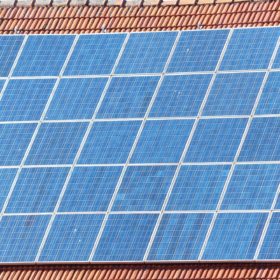
China’s National Development and Reform Commission (NDRC) has allocated RMB500 million (US$78.1 million) for the incentive scheme for residential PV in 2021. Chinese electronic engineer TBEA is set to raise its controlling stake in polysilicon manufacturer Xinte Energy as it attempts to fund a planned 100,000-tons-per-year fab in Inner Mongolia.
Has China extended solar grid-connection deadlines by a year?
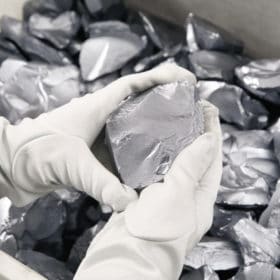
Such a decision, which industry body the CPIA is adamant has already been announced, could make all the difference to investors struggling with a surge in equipment costs fueled by the polysilicon shortage. The all-important National Energy Administration, however, has yet to confirm whether the CPIA’s interpretation is correct.
Indian PV manufacturer expands output capacity to 2.5 GW
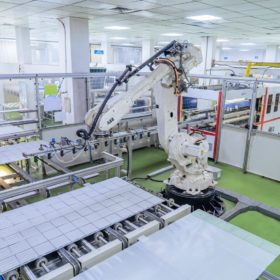
Goldi Solar is setting up a 2 GW factory in the Indian state of Gujarat, increasing its manufacturing capacity to 2.5 GW. The new facility will use micro-gap module technology to produce mono-facial and bifacial modules with peak power outputs exceeding 600 W.
