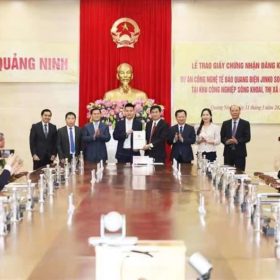
JinkoSolar builds 7 GW wafer factory in Vietnam
The new factory should begin production within six months and serve the company’s cell and module assembly factories in Malaysia, as well as the module assembly facility in the United States.
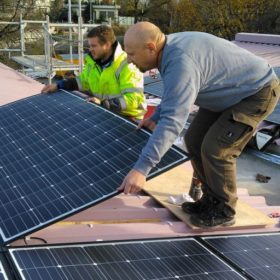
Energy transition to create 60m solar jobs by 2050
The switch from fossil fuels and nuclear will bring a jobs dividend thanks to the greater labor-intensity of renewables plants, according to a paper published by Finland’s LUT. However, the jobs dividend is unlikely to be evenly spread around the world, with Europe set to be a big winner.
Taiwan’s URE Corp deploys production line for M6, M8 solar modules
The new capacity is expected to meet domestic solar module demand, which the PV manufacturer expects will significantly increase in the second half of this year.
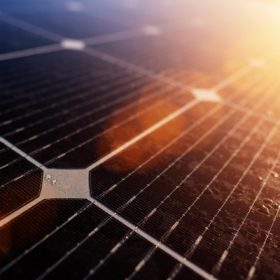
Palestine launches tender for 20 MW solar module assembly line
The line will be used in a new PV panel assembly factory located in the West Bank of Palestine which is set to begin manufacturing activities next year.
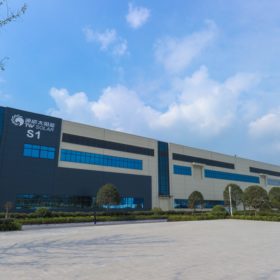
The Chinese PV Industry Brief: Tongwei raises solar cell prices
Canadian Solar also reports solid Q2 results, with PV shipments reaching 3.7 GW and revenue totaling US$1.43 billion.
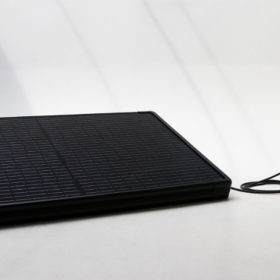
Plug-and-play solar module from the Netherlands
Supersola has developed a 315 W, half-cut monocrystalline PV module. It costs €699 and can be coupled with other two panels to form a 1 kW residential PV system.

Ligand-free perovskite quantum dot solar cell with 9.3% efficiency
The quantum dots used for the device are based on methylammonium lead iodide and are synthesized within a porous silica (SiO2) matrix. Compared to its bulk counterparts, the ligand-free solar cell exhibited a more stable performance.

German manufacturer unveils 10-busbar, half-cell PV modules
Bauer Solartechnik GmbH has released its new 400 W and 405 W BS-M10 PV panel series for rooftop projects.

Australian science agency looks to space to test next-gen PV cell tech
The Commonwealth Scientific and Industrial Research Organisation is pushing the limits of flexible solar PV cells by partnering with Australian startup Space Machines Company to test the technology in space.

Chinese PV Industry Brief: Polysilicon and wafer prices rise again
Trina Solar is also looking to raise financing for its plans to increase PV cell and module capacity.
