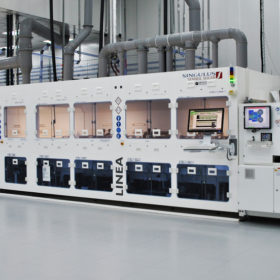
Kazatomprom again seeks to sell solar manufacturing units
The Kazakh state-owned national atomic energy company is seeking to sell its solar manufacturing units for the second time.
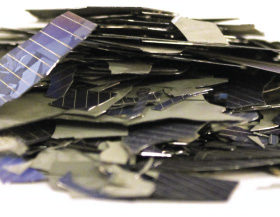
Establishing a solar module recycling system in India
Ankit Kapasi and Kishore Ganesan from SOFIES India are working on the Solar Waste Action Plan (SWAP) project in India, which is looking to investigate both the technical and economic feasibility of a PV module recycling system in the country. The pilot has been funded by Signify Foundation and Doen Foundation. The team at Sofies is working closely with technology partner Poseidon Solar and established the first PV recycling pilot plant in September 2020. The duo spoke to pv magazine India about their plant’s techno-commercial feasibility and the Indian eco-system’s readiness for PV module recycling.
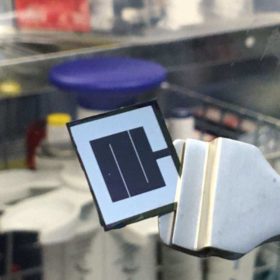
PV trends of 2020: Part 4
Despite much of the world being on lockdown for a big chunk of 2020, there are few who could say it has been an uneventful year. And while the ongoing Covid-19 pandemic will be what defines 2020 for many, in the solar industry there’s plenty more to shout about, from the rapid rollout of high-powered modules to a drastic increase in carbon-neutral pledges from companies and governments around the world. Across five installments, pv magazine takes a look back at the year in solar. First up were the U.S. election and carbon neutral pledges, followed by auctions and green bonds, and big modules and renewable grid support. Next up are high-efficiency EU cell production and perovskites.
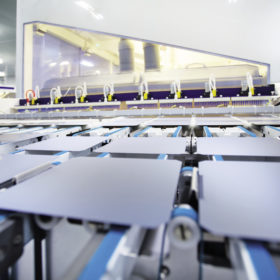
PV trends of 2020: Part 3
Despite much of the world being on lockdown for a big chunk of 2020, there are few who could say it has been an uneventful year. And while the ongoing Covid-19 pandemic will be what defines 2020 for many, in the solar industry there’s plenty more to shout about, from the rapid rollout of high-powered modules to a drastic increase in carbon-neutral pledges from companies and governments around the world. Across five installments, pv magazine takes a look back at the year in solar. First up were the U.S. election and carbon neutral pledges, followed by auctions and green bonds. For day three, you can read about big modules and renewable grid support.

Chinese PV Industry Brief: Intense M&A activity and two more factories
Longi and Tongwei have both seen changes in ownership in recent days. Meanwhile, Maxwell Technology has unveiled a plan to build a heterojunction cell factory Jiangsu Province and the Henan Group has entered PV glass and module production.

Artificial intelligence in photovoltaic production
Five scientific institutions in Germany are currently working together on self-learning production plants that use process data for the permanent optimization of manufacturing. The initiative is aimed at making the settlement of photovoltaic factories in Germany and Europe attractive again.

Thermal model to predict PV panel temperature
Scientists in Turkey have tested a transient thermal model to predict PV module temperature during a five-day interval in June. The model considers the heat capacity of a PV module, which is usually not provided by manufacturers in their product sheets, as a parameter for temperature prediction.

Australian research improves scope, efficiency of PV light sensitizers
Australian scientists have developed an algorithm to increase both the efficiency and compatibility of light sensitizers in solar panels.
Oxford PV retakes tandem cell efficiency record
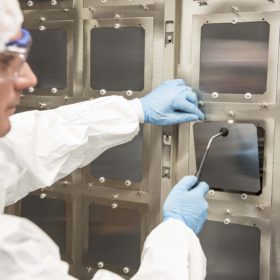
Perovskite developer Oxford PV has set a new world record for perovskite-silicon tandem cell efficiency at 29.52%, edging out the previous record set less than a year ago by Helmholtz Zentrum Berlin. The new record has been certified by the U.S. National Renewable Energy Laboratory.
Vanadium redox flow battery integrating CIGS modules
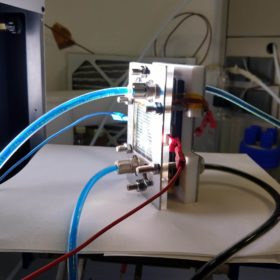
Spanish and Finnish scientists have developed a solar vanadium redox flow battery paired with commercially available CIGS solar panels. The open-circuit voltage values were high enough to achieve unbiased photocharge, they said.
