Shangji Automation launches PV module production with 16 GW factory
Shangji Automation has announced plans to invest CNY 5 billion ($726 million) in a new 16 GW factory. Commercial production is scheduled to start in the third quarter of 2023.
Kosol Energie buys 850 MW PV module production line from SC Solar
India’s Kosol Energie is expanding its annual PV module production capacity to 1.1 GW with the installation of a new 850 MW line from SC Solar. It is aiming for 1.9 GW of cumulative PV module capacity by the end of the current fiscal year.
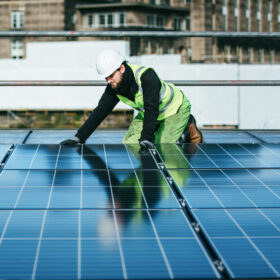
Summit Ridge Energy procures 1.2 GW of US-made Qcells panels
Summit Ridge Energy’s latest order marks the largest domestic community solar purchase of PV modules in US history. It includes 20 MWh of Qcells Geli energy storage systems.

Grew Energy wins 2 GW of wafer-to-module capacity in India
India’s Grew Energy will secure $69.3 million of incentives for 2 GW of integrated wafer-cell-module production.
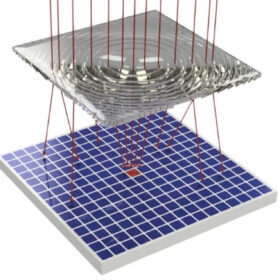
Taiwanese scientists develop high-concentration PV system
Taiwanese researchers have developed a system featuring a 2 × 2 Fresnel lens array and a solar panel made of III-V materials and polycrystalline solar cells, with low light leakage.
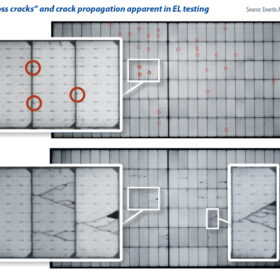
Bigger modules, bigger headaches?
The debate continues over whether super-sized, high-power solar modules are a good thing for the industry and they appear to be here to stay. Vicente Parra and James Whittemore, from Enertis Applus+, consider the pitfalls to avoid when designing high-power solar projects.
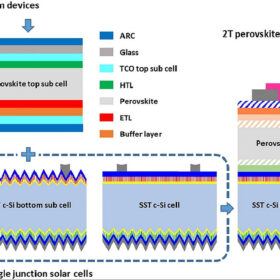
Poly-SiOx solar cell for 4T, 2T perovskite-silicon tandem devices
Scientists in the Netherlands have developed a new crystalline solar cell based on poly-SiOx passivating contacts. The poly-SiOx tech results in a 20% efficiency rating, but 4T tandem perovskite-silicon solar cells based on the poly-SiOx cell can reach an efficiency of 28.1%, and 2T tandem perovskite-silicon devices can hit 23.2%.
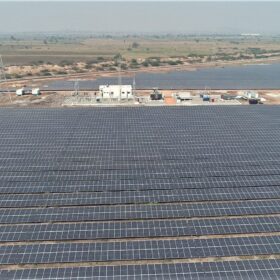
Amp Energy India secures 1 GW of solar cell, module capacity under PLI scheme
Amp Energy India has won $17 million of incentives to set up 1 GW of integrated solar PV cell and module production capacity.
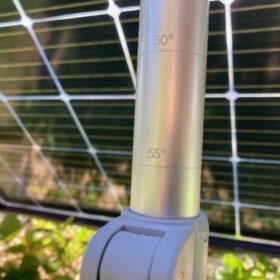
French startup offers ‘manual’ solar tracker for residential PV systems
France-based Luciole & Basilic has developed a tracking system that can be manually oriented according to the zenith every 15 days. The startup recently introduced the first prototype and is now looking for distributors.

India’s Jakson buys 600 MW PV module production line from Jinchen
Jakson says its new, fully automated manufacturing line will produce the latest p-type, n-type, and G-12 solar modules, in both mono-facial and bifacial formats.
