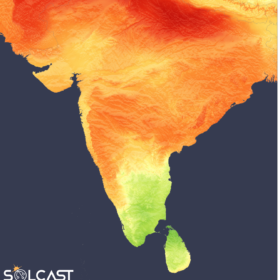
Solar surge in Northern India as Cyclone Ditwah cuts irradiance in the south and Sri Lanka
In a new weekly update for pv magazine, Solcast, a DNV company, reports that November brought above-average solar conditions in northern India and Pakistan, while southeastern India and Sri Lanka faced reduced solar output due to Cyclone Ditwah’s storms and heavy cloud cover. Despite southern disruptions, India’s renewable energy share rose, driven by strong solar generation in the north and overall growth in renewable capacity.
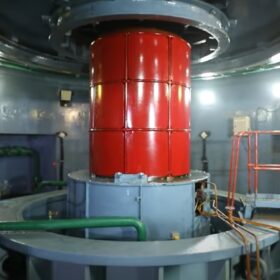
India’s THDC commissions new unit of 1 GW pumped storage project
THDC India Ltd., a subsidiary of NTPC Ltd., has commissioned a 250 MW unit of its 1 GW variable-speed pumped storage hydropower project in Uttarakhand.
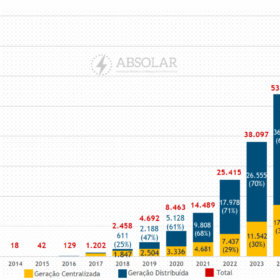
Brazil to add 11.4 GW of solar in 2025 despite regulatory hurdles
Brazilian photovoltaic association ABSolar says solar capacity additions may fall 24% to 10.6 GW in 2026 from 15 GW in 2024, with regulatory barriers, high capital costs, and restricted self‑generation access slowing investment and reducing jobs.

Bangladesh reinstates 11 solar plants totaling 918 MW after tariff cuts
Bangladesh reinstated approvals for 11 solar plants with a combined capacity of 918 MW after developers agreed to lower tariffs, in a move expected to save the government BDT 11.69 billion ($96.2 million) per year.
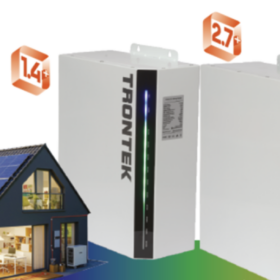
India’s Trontek enters home storage market with new lithium systems
Trontek has entered India’s residential energy storage market with its Powercube 1.4 kWh and 2.7 kWh lithium-ion systems for solar and grid backup.
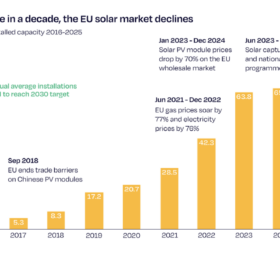
EU installs 65.1 GW of solar in 2025
The European Union’s solar fleet has reached 406 GW, surpassing the EU Solar Strategy’s 400 GW goal for 2025, but SolarPower Europe says the sector’s first contraction in a decade is putting the bloc’s 750 GW target for 2030 at risk.

Great British Energy doubles fund, commits $1.3 billion for manufacturing
Scotland, Wales and Northern Ireland to benefit from extra funding for community projects. Investment granted to fund renewable energy schemes and solar panels on public sector buildings.

Zimbabwe plans 600 MW floating PV project
Government officials in Zimbabwe have said work on a 600 MW floating solar project on Lake Kariba, the world’s largest artificial lake by volume, will be begin next year, starting with an initial 150 MW phase.
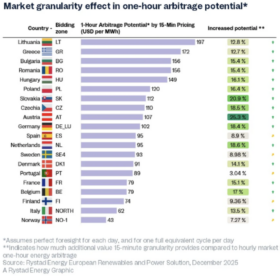
EU shift to 15-minute trading supports battery storage profits, says Rystad
Europe’s move to 15-minute spot-market intervals, effective Oct. 1, is altering the economics of battery storage, with Rystad Energy estimating that battery energy storage systems (BESS) profits in some countries have increased by more than 20%.

Beijing group creates official entity to guide China’s polysilicon capacity
Industry analysts say a new Beijing-based coordination platform created by China’s top polysilicon producers signals a turn toward managed capacity, as the sector tries to halt a steep price slide and mounting consolidation pressures.
