
AccelerateEU backs 200 GW storage goal but omits dedicated mechanism
The European Commission’s AccelerateEU energy crisis plan endorses a 200 GW battery storage target for 2030 but proposes no dedicated financing mechanism to reach it, according to SolarPower Europe (SPE), which is calling for a separate EU-wide auction funded by emissions trading revenues.
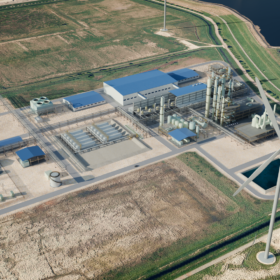
Dutch government grants priority status to planned polysilicon factory
The Ministry of Economic Affairs and Climate of the Netherlands has identified a planned polysilicon factory in the country as of strategic importance under the Net Zero Industry Act.

Colombia reopens long-term energy contracting with new renewables auction
Colombia has launched a 15-year auction scheme to procure solar, storage, and hybrid capacity, with delivery starting in 2030. The mechanism introduces time-of-use products and aims to improve reliability while expanding renewable energy uptake.
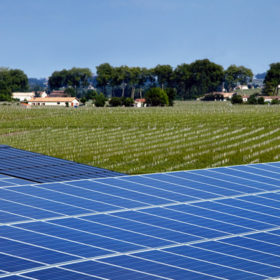
France streamlines renewables environmental permitting with new provisions
Published in the French Official Journal on April 22, a new decree aims to speed up the handling of appeals against strategic environmental projects, particularly in the renewable energy sector. It introduces direct access to administrative courts of appeal and tightens rules on deadlines and procedures for challenging projects.
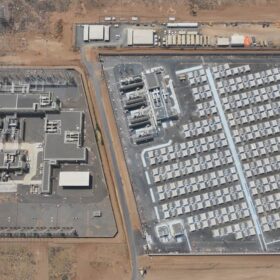
Saudi Arabia launches qualification process for 12 GWh of battery storage projects
The program comprises six projects with a cumulative power output of 3 GW, each designed to provide four hours of storage duration.

Bangladesh launches tenders for 77.6 MW of solar
Bangladesh’s BPDB has tendered 77.6 MW of solar capacity across three projects in Chittagong, Rangamati, and Dinajpur. The plants will be developed on a turnkey basis with funding from BPDB and the Power Sector Development Fund.

EU moves to restrict funding for projects using inverters from high-risk suppliers
The EU is moving forward with a plan to restrict funding for PV projects using inverters from high-risk suppliers, citing cybersecurity concerns and issuing new guidance to phase them out. A transition period applies for certain projects linked to the EU grid, while others must exclude such suppliers by 2027.
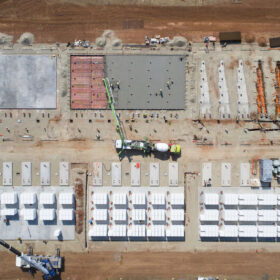
Long-duration battery storage can contribute to security of supply more cost-effectively than gas-fired power plants, LCP Delta finds
LCP Delta has conducted a study analyzing the potential contribution of long-duration battery storage to security of supply within capacity tenders in Germany, including an economic comparison with gas-fired power plants and the resulting costs to the public. However, the authors explicitly note that they are not advocating for a complete phase-out of new gas-fired power plants.

Sun’s out, load’s gone: The evolution of Australia’s National Electricity Market
Q4 2025 in South Australia saw grid-connected loads with spot price exposure actually being paid to use electricity about half the time (46%) – and that electricity was overwhelmingly (80%) supplied by renewables. This demonstrates a shift from managing demand to quietly needing it. Particularly in regions like South Australia, there is growing demand for demand.
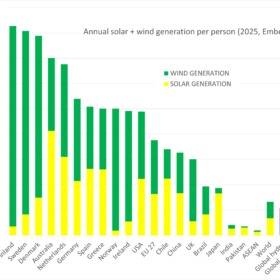
Solar and wind take over global power growth in 2025
In 2025, solar and wind dominated global energy growth, delivering around six times more new capacity than all other power sources combined and supplying nearly all new electricity demand. With rapid expansion led by countries like Australia and several European nations, solar and wind are now the fastest-growing and central drivers of the global energy transition.
