Where will lithium-ion battery prices go in 2025?
After tumbling to record low in 2024 on the back of lower metal costs and increased scale, lithium-ion battery prices are expected to enter a period of stabilization.

Spain announces 820 MW of energy storage projects for Q4 2024 applications
More than 182 MW of the battery energy storage systems (BESS) highlighted in Spain’s Official State Gazette (BOE) are for hybridization with existing solar and wind generation capacity.

Ukraine adds over 800 MW of solar in 2024
The Solar Energy Association of Ukraine says the country installed 800 MW to 850 MW of solar capacity in 2024, driven mainly by business and residential installations.
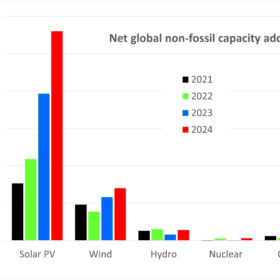
The fastest energy change in history continues
Solar and wind are being installed at a rate that is five times faster than all other new electricity sources combined. This offers compelling market-based evidence that PV and wind are now the most competitive and practical methods for deploying new generating capacity.
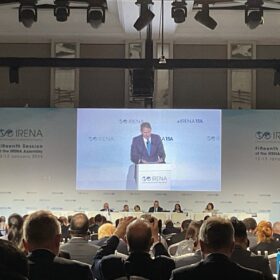
IRENA Assembly 2025: Unequal access to clean energy finance needs attention
Urgent responsibility was the overriding theme of the 15th annual International Renewable Energy Agency (IRENA) assembly, which convened on Jan. 12 in Abu Dhabi.
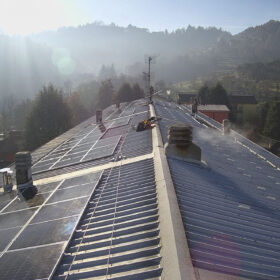
Energy communities should be supported via network tariff adjustments
New research from Belgium shows that energy-sharing alone is not attractive enough for citizens and businesses willing adopt solar through an energy community. According to the study, policy support for energy communities should take the form of network tariff adjustments reflecting the community’s measurable benefits for the distribution grid.

European solar market 2024-2025: balancing growth, challenges and opportunities
Markus Hoehner and Rajan Kalsotra, CEO and Senior Consultant at the Bonn-based EUPD Research, discuss the growth trajectory, challenges and opportunities within the EU solar PV market, focusing on policy support, pricing trends, module shipments and future projections.

From equality to equity: powering inclusive leaders in the solar sector
This week, Women in Solar Europe (WiSEu) reflects on the need for tangible DEI practices and inclusive leaders who understand the meaning of equity and diversity to create inclusive environments that acknowledge individual needs and systemic barriers. Addressing these aspects is critical to fuel innovation, creativity, and resilience to overcome the challenges of our sectors in the energy transition.
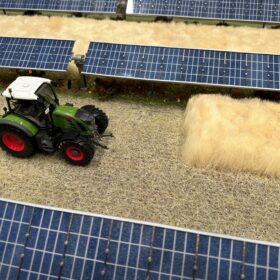
Czechia approves new laws for agrivoltaics
The Czech government has approved new legislation for agrivoltaics. The measures extend the amount of crop types that agrivoltaics can be deployed on and defines two categories of permissible agrivoltaic systems.
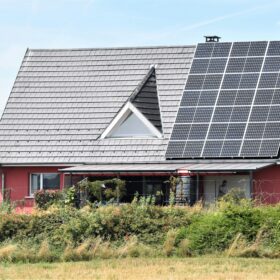
New rules allow VPPs to compete in Australia’s energy market from 2027
The Australian Energy Market Commission (AEMC) has released a final determination to allow virtual power plants (VPPs) to compete directly with large-scale generators in the energy market, scheduled to begin in 2027.
