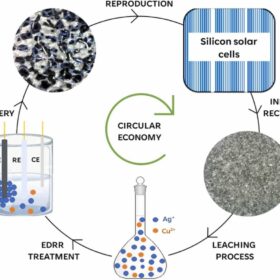
New process to recover silver from end-of-life solar cells achieves 98% efficiency
Scientists have used hydrometallurgical and electrochemical processes to recover pure silver from solar cells. The proposed technique also utilizes a method known as electrodeposition-redox replacement, which reportedly increases the silver recovery rate.

Scientists design dichalcogenide solar cells based on tungsten diselenide
The researchers outlined a “scalable” manufacturing process that reportedly results in a tungsten diselenide film with an efficiency of up to 22.3%. The proposed technique could facilitate the mass production of high-efficiency multilayer WSe2 solar cells at low cost.

Indian initiative to commercialize new zinc-ion battery tech
Indian mining company Hindustan Zinc will collaborate with the Bangalore-based Jawaharlal Nehru Centre for Advanced Scientific Research (JNCASR) to develop new zinc alloys for use as anodes in zinc-ion batteries and electrolytes for use in rechargeable batteries.

Ideal Heating launches new air source heat pump series
The UK-based manufacturer said the new Ecomod products have a size ranging from 14 kW to 70 kW and a coefficent of performance of up to 4.85.

Automating solar PV perovskite material discovery
U.S. researchers have applied robotics and automation to perovskite material discovery for use in tandem perovskite solar cell technologies. The robotic platform is multifunctional, able to mix precursors, perform spin coating, annealing and characterization of the optoelectronic thin films.

Nanoparticles, phase-change materials in PVT systems
Scientists have used varying levels of Al₂O₃ and ZnO paraffin wax to improve the electrical and thermal performance of a photovoltaic-thermal (PVT) system. They have also developed a prediction model for this specific combination of hybrid nano-phase change materials.

The Hydrogen Stream: NEOM starts recruitment campaign for ‘world’s largest’ green hydrogen plant construction
The green hydrogen plant, which is an equal joint venture between ACWA Power, Air Products and NEOM, will produce up to 600 tonnes of carbon-free fuel daily when fully operational at the end of 2026.

Novel blockchain-based virtual utility for P2P PV trading
Researchers from Canada’s Western University have developed an open-source, blockchain-based virtual utility for peer-to-peer (P2P) solar trading, using smart contracts to save up to $1,600 (US dollars) for 10 homes in simulated scenarios.

How much shade is enough?
Researchers have covered part of a rooftop solar plant with a different numbers of shading cloth layers to measure their power, current, and voltage. They have been able to identify a point after which the value of system current and maximum power is no longer sensitive to shading heaviness.
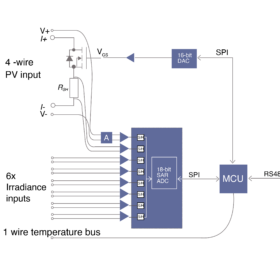
Monitoring system for vehicle-integrated photovoltaics
Researchers in Slovenia have built a monitoring system for vehicle-integrated photovoltaics consisting of an IV curve scanner that uses a MOSFET as a voltage-controlled electronic load. The system also utilizes an 18-bit analog-to-digital converter and a microchip microcontroller.
