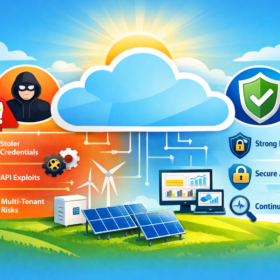
Cyber threats for PV: What are cloud platform and software-as-a-service exploitation attacks and how do they work
Cloud and SaaS platforms are now central to PV plant operations, but their centralization creates a high-impact cybersecurity risk where a single compromise can expose or disrupt entire fleets of installations. Attackers exploit weaknesses like stolen credentials, insecure APIs, multi-tenant flaws, and platform vulnerabilities, making strong identity controls, secure APIs, and continuous monitoring essential defenses.
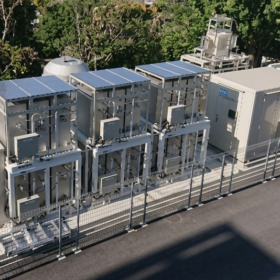
Low-pressure hydrogen bridges seasonal gaps in solar-powered Japanese building
Taisei Corporation has demonstrated that a building can operate entirely on solar power by combining PV generation with a hybrid storage system integrating batteries and low-pressure hydrogen at a test facility in Yokohama. An EMS-enabled setup using lithium-ion batteries and PEM electrolysis balanced short- and long-term energy supply and demand, enabling year-round renewable operation, according to the company.

TBEA launches 500 kW string inverter
The new inverter is designed around standardized 5 MW and 5.5 MW PV sub-arrays with the aim to reduce balance-of-system costs. It features a maximum efficiency of 99.0% and a high-voltage architecture of up to 1,600 Vdc and 1,000 Vac.

JinkoSolar debuts rooftop PV module weighing 7 kg/m2
The Chinese manufacturer said its lightweight Light Diamond TOPCon module delivers 560 W at 24.94% efficiency.

Trina Solar TOPCon patents invalidated in US ruling involving Canadian Solar
The U.S. Patent and Trademark Office has invalidated all claims of two TOPCon solar cell patents previously asserted by Trina Solar against Canadian Solar subsidiaries.

Cyber threats for PV: What are supply chain attacks and how do they work
Supply chain attacks compromise PV systems by targeting trusted vendors, software, or hardware components, allowing attackers to infiltrate systems indirectly through legitimate channels. These attacks can disrupt operations, introduce hidden vulnerabilities, and impact multiple assets at once, making vendor security and system validation critical for resilience.
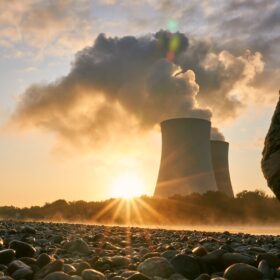
New metric shows renewables are 53% cheaper than nuclear power
A new metric for assessing total system costs puts a least-cost mix of offshore wind and solar at about €46 ($54.20)/MWh in a future climate-neutral energy system for Denmark. Researchers tell pv magazine that figure is less than half the equivalent cost of nuclear under the same conditions.
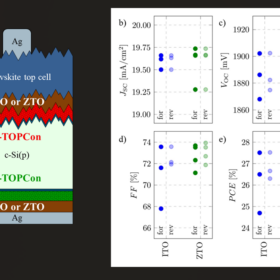
Perovskite–silicon tandem solar cells using zinc-doped tin oxide achieve comparable performance to indium tin oxide counterparts
Fraunhofer ISE-led researchers demonstrated zinc-doped tin oxide (ZTO) as an indium-free alternative to indium tin oxide (ITO) for recombination layers in fully textured perovskite–silicon tandem solar cells. ZTO delivers comparable device efficiencies of 27–28% under current-matching conditions, offering a scalable, indium-free pathway for high-performance tandem photovoltaics without efficiency loss.

Switzerland to fund research on PV module, battery, heat pump recycling
The Swiss federal government has launched a funding call for research projects on energy and resource-efficient industrial processes, including the circular economy related to solar modules, batteries, heat pumps and electrolyzers. The deadline to submit pre-proposals is June 30.
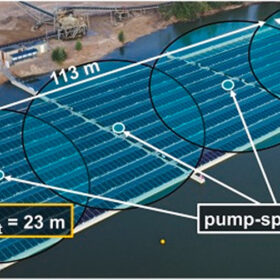
Spray cooling for floating PV
A research team in Germany developed a dynamic model of spray cooling for floating PV systems that couples thermal behavior, electrical performance, and active cooling, and validated it against a 750 kW installation. Simulations across four climates showed that spray cooling reduces module temperatures by up to 42% and improves energy yield by up to 3.8%, with benefits strongly dependent on local conditions.
