
EneCoat to accelerate perovskite PV production
EneCoat Technologies, a Japanese solar perovskite developer, has raised JPY 5.5 billion ($35 million) from new and existing investors to finance new collaborations based on its low-temperature production process.
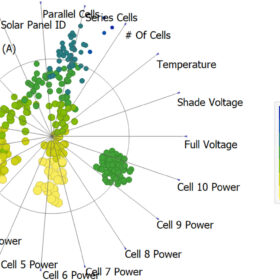
k-Nearest Neighbors algorithm for PV power forecasting
Scientists in Iraq used a k-Nearest Neighbors algorithm to evaluate the operational status of PV modules under various conditions, including partial shading, open circuit, and short circuit scenarios. They found that the overall performance of the model in predicting power output was “notably accurate.”
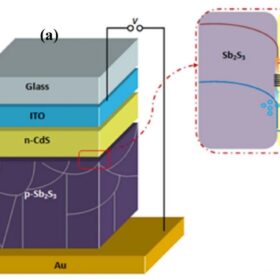
New design for antimony trisulfide solar cells promises 30% higher efficiency
An international research team has proposed a series of optimization techniques for antimony trisulfide (Sb2S3) solar cells that may reportedly increase the efficiency of these PV devices to over 11%. The resulting new cell design is said to significantly improve band alignment control and parameter optimization.

Scientists say concavities in perovskite films may improve solar cell stability
Hong Kong University of Science and Technology (HKUST) researchers have gained insights into perovskite microstructure. After removing grain surface concavities in the crystalline grains of perovskite, they fabricated a solar cell with improved efficiency retention under standardized thermal cycling, damp heat, and maximum-power-point tracking tests.

German startup offers self-adhesive film for glare-free PV modules
Germany-based Phytonics has developed a self-adhesive film with microstructures to reduce glare on PV modules. It is available in sheets and rolls for new and existing PV systems.

First Solar probes potential infringement of TOPCon patents
First Solar says it is evaluating potential infringement of its patents for its tunnel oxide passivated contact (TOPCon) tech, secured through the acquisition of TetraSun in 2013. The US thin-film solar module manufacturer has not named the companies involved or given a timeline for the investigation.
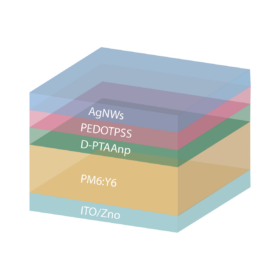
Organic solar cell based on PEDOT:PSS hole transport layer achieves 17.1% efficiency
A team of researchers in Germany has fabricated a non-fullerene acceptor-based organic photovoltaic cell featuring a bilayer solution-processed hole transporting layer. It recorded a power conversion efficiency of 17.1% and maintained 93% of its initial efficiency after 1,800 hours under continuous solar cell operation at 60 C.

Water-source heat pump integrating cooled photovoltaic panels, thermal storage
Researchers in Italy have designed a water-source heat pump system intended for generating cooling, heating and domestic hot water in social housing stock built during the 1970s–1990s. The novel concept integrates photovoltaic-thermal energy with thermal storage and promises a seasonal coefficient of performance of 5.

Norway has potential to deploy 31 GW of solar in buildings
A research group has examined the potential for PV on building walls and rooftops across Norway. It says that up to 36% of the feasible solar energy, or approximately 31 GW, could be integrated into the national power system to match generation and consumption patterns.

First Solar opens US research facility
First Solar has commissioned the Jim Nolan Center for Solar Innovation in Lake Township, Ohio. It includes a high-tech pilot manufacturing line to produce full-sized prototypes of thin-film and tandem PV modules.
