
Australian researchers hit 27.06% with triple-junction perovskite cell
A team of researchers led by the University of Sydney has fabricated a triple-junction perovskite-perovskite-silicon tandem solar cell that achieved a power conversion efficiency of up to 27.06% and set new standards for thermal stability.
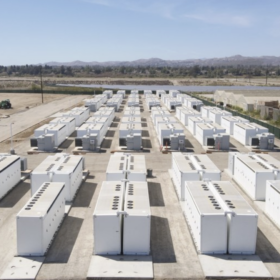
Operational faults cut returns in 19% of battery storage projects
A recent report from battery intelligence firm Accure reveals that while most battery energy storage systems (BESS) operate reliably, nearly 19% of projects experience reduced returns due to technical issues and unplanned downtime.

Chemitek Solar launches cleaning solutions for agrivoltaics
Portugal-based Chemitek Solar is developing biodegradable cleaning and anti-soiling products for PV panels that share land use with agricultural production.

Scientists develop new floating box array for offshore PV
Researchers have tested a 9 x 11 floating box array for offshore photovoltaics in a large wave flume, under regular and irregular wave sequences. They have placed wireless gyroscopes on three of the boxes, representing the front, middle, and rear positions.

Solar fridges for the developing world
As climate change leads to more electricity blackouts and brownouts, the reliability of everyday refrigeration is at risk. A new IEC Standard, together with solar innovations in Africa and Asia, demonstrates how cooling can continue when power grids falter.
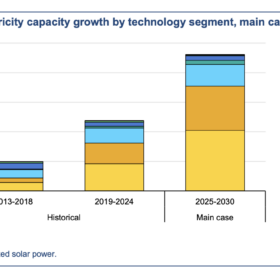
IEA lowers 2025-30 forecast for solar growth
The International Energy Agency (IEA) cut its 2025–30 renewables forecast by 5%, citing lower solar additions, though PV still represents nearly 80% of 4.6 TW expected growth.
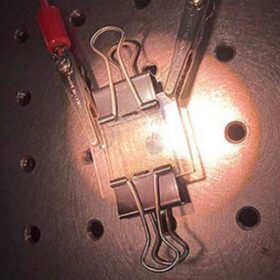
Researchers discover photovoltaic properties in zinc-based film
Research from the University of Wisconsin-Milwaukee has found zinc-phosphate-hydrate (ZPH) films are capable of producing electricity from light. The coating’s photovoltage was amplified when anthocyanin, a natural dye found in blackberries, was added.
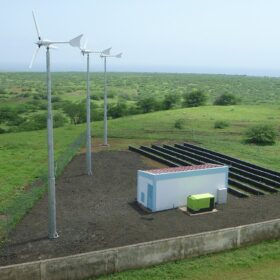
Optimal sizing for AC multi-bus microgrids based on solar, storage
A French–Moroccan research group has developed a two-stage hierarchical techno-economic model to optimize AC multi-bus microgrids in remote areas. This microgrid configuration is more complex than that of standalone systems but offers several advantages in terms of cost efficiency and energy reliability.
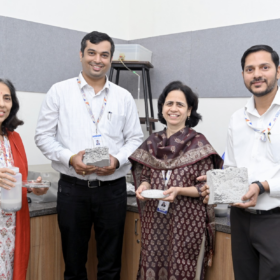
Indian scientists create scalable recycling process for solar waste
Researchers at India’s MIT World Peace University have developed a scalable process that recovers valuable materials from retired solar panels and converts residual waste into construction products, promoting a circular solar economy.

Japan launches R&D call for tandem perovskite solar cell mass production
Japan’s New Energy and Industrial Technology Development Organization (NEDO) is accepting proposals for a six-year R&D program to advance large-scale manufacturing technologies and field testing of next-generation tandem perovskite solar cells.
