
Optimum tilt angle for PV systems ranging from 0° to 90°
A Slovak research team has developed a mathematical model for determining the optimum tilt angle of a solar system ranging from 0° to 90°. Their framework was tested on an experimental setup in Czechia and attained 93.9% accuracy in predicting the system’s energy balance.
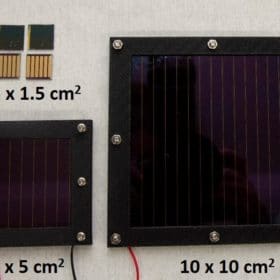
Japan launches subsidies to accelerate perovskite solar deployment
The Japanese government has launched applications for two targeted funding schemes to accelerate deployment of lightweight perovskite solar tech and incentivize battery-backed systems that enhance grid resilience and economic viability.

Solar-Fabrik debuts back-contact solar module for residential, C&I applications
The German manufacturer said its full-black back-contact solar panel has a power conversion efficiency of up to 23.52%.

Stochastic optimization for PV-powered EV charging stations
Scientists have developed a new optimization approach that combines both day-ahead optimization and real-time optimization to improve operations of PV-driven EV charging stations. The framework is based on the autoregressive moving average and the Latin hypercube sampling models.

Xpanner launches robotic automation kit to retrofit solar pile drivers
The U.S. startup offers a new kit to integrate robotic automation with existing equipment.

The Hydrogen Stream: Japanese researchers develop low-temperature hydrogen battery
Institute of Science Tokyo researchers proposed a battery with magnesium hydride (MgH2) as the anode and hydrogen (H2) gas as the cathode. Meanwhile, researchers at Chung-Ang University proposed chloride-resistant ruthenium (Ru)-based nanocatalysts for direct electrolysis and hydrogen production from seawater.
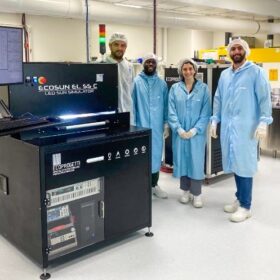
IPVF testing new perovskite solar PV testing platform from Ecoprogetti
The French research institute has added to its perovskite solar cell and module pilot line an Ecoprogetti integrated testing platform that combines a solar simulator with advanced electroluminescence (EL) analysis.
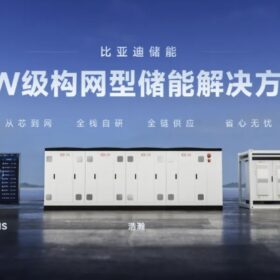
BYD unveils 14.5 MWh storage system, world’s largest yet
China’s EV giant has unveiled the 14.5 MWh DC “Haohan” single-unit DC block with record-breaking capacity to challenge next-generation energy storage market.

Tiny pinholes can lead to device failure in perovskite solar cells
Researchers in the United States have found microscopic pinholes in perovskites are responsible for the breakdown of such solar cells when under reverse bias conditions. They say the findings should push scientists and engineers to prioritize the production of pinhole-free films to make perovskites more robust and stable.
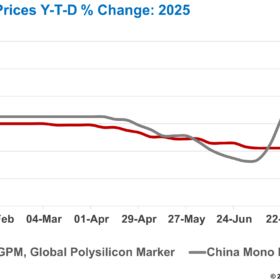
China polysilicon prices climb 50.7% from July low despite growing inventories
In a new weekly update for pv magazine, OPIS, a Dow Jones company, provides a quick look at the main price trends in the global PV industry.
