
Italy set to host a battery gigafactory
Italian start-up Italvolt wants to build a €4 billion EV battery manufacturing facility in Italy. The site for the project is currently being identified, and the factory’s initial capacity should reach 45 GWh.
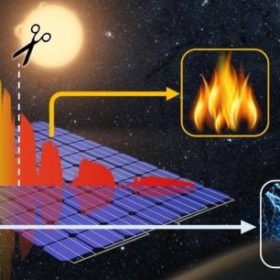
Spectral-splitting filters for more efficient photovoltaic-thermal panels
A British-Chinese research group has created a new framework to assess the performance and efficiency limits of photovoltaic-thermal solar panels. They say that the improvement of spectral-splitting (SS) filters in the devices will be the key to their future commercial success.
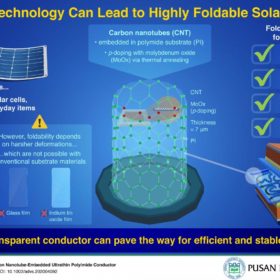
A 15.2%-efficient solar cell that you can fold in half
Scientists in South Korea developed a foldable thin-film device with some promising characteristics. Integrating a perovskite cell material and a carbon nanotube electrode, the group fabricated a device that achieved 15.2% efficiency and could withstand being folded more than 10,000 times at a bending radius of 0.5mm.
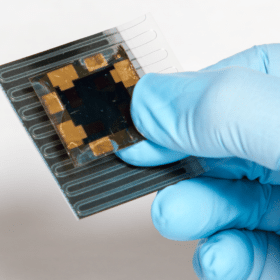
Solliance, MiaSolé hit 26.5% efficiency on tandem CIGS/perovskite solar cell
MiaSolé and Solliance have achieved record performance by optimizing the bandgap and the efficiency of both the rigid semi-transparent perovskite top cell and the flexible CIGS bottom cell.

India joins race to develop high-efficiency solar cells
India’s Ministry of New and Renewable Energy is funding research to develop high-efficiency crystalline silicon solar cells, as well as perovskites.

UK solar innovator planning unique thin film pilot
UK-based company Power Roll has picked up £5.8 million in investment over the past six months and plans to begin pilot production this year. The company has developed a unique flexible thin-film technology, which promises to combine both solar generation and storage.
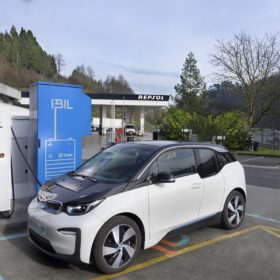
Spain introduces EV charging stations using second-life batteries
Spanish companies Repsol and Ibil have launched the first charging station for electric vehicles with energy storage. The system reuses batteries from electric buses.
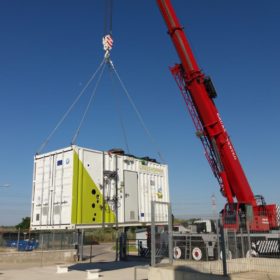
Abengoa completes construction on pilot green hydrogen plant
Abengoa Innovación has completed the construction of the pilot plant for the Grasshopper project, which is in the commissioning and start-up phase in Seville. The plant will be then transferred to its final location – the Netherlands.
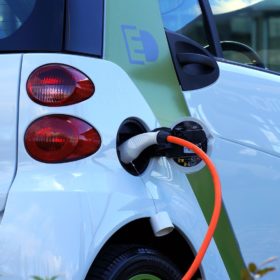
US automakers embracing EV revolution
Ford, Toyota, and the U.S. government have all taken huge steps toward getting more electric vehicles on the roads, and the American Council for an Energy-Efficient Economy has released a report outlining which states are keeping pace.

Modeling the potential of lead-free perovskites
Scientists in India modeled the performance of tin-based perovskite (methylammonium tin triiodide) finding that with careful optimizations the material could achieve efficiencies beyond 28%.
