
Electricity and hydrogen, from one cell
Scientists at the United States Department of Energy’s Lawrence Berkeley Laboratory have created a hybrid device which can produce both hydrogen via water splitting and electricity via photovoltaics.
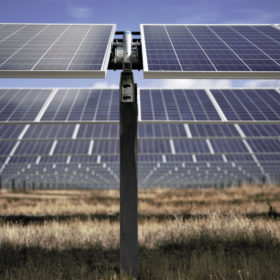
The weekend read: On track for broader horizons
The global vertical integration of the PV tracker industry is accelerating, as players seek to build organizations that can provide manufacturing and support in multiple markets simultaneously. These partnerships tend to connect intellectual property assets with global manufacturing capability and construction and engineering teams that have the financial wherewithal to pursue international markets. The trend also is driving product line expansion, as in the case of Nextracker’s offering of energy storage as an integrated part of its tracker design.
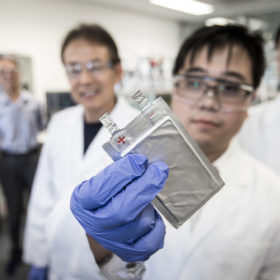
Australia: Sodium-ion batteries get commercial rollout as li-ion alternative
Sydney Water’s Bondi sewage pumping station will soon be storing solar energy through the use of 30 kWh of sodium-ion batteries, a cheaper alternative to the traditional lithium-ion batteries.

Bill Gates to establish €100 million clean energy fund with EU
If plans are realized, the private-public investment vehicle will start investing in companies with green-tech innovations. The fund would be used to pursue technologies which could help the decarbonization of the economy but which have not received enough attention.

Japanese utility KEPCO tests blockchain technology to determine value of surplus solar power
The power supplier is cooperating with the University of Tokyo, Mitsubishi UFJ Bank and Unisys, testing how solar power can be traded between solar prosumers and electricity consumers, while conducting transactions using a blockchain platform.
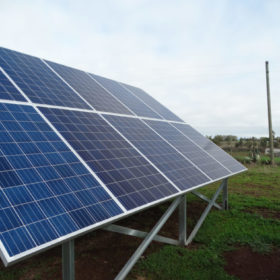
Use of PV can reduce diesel consumption in energy-intensive cultivation in southern Europe
Italian, Spanish and Portuguese scientists have published a study about energy consumption and the environmental footprint of the use of solar-hybrid irrigation systems in olive plantations in Portugal and Morocco.
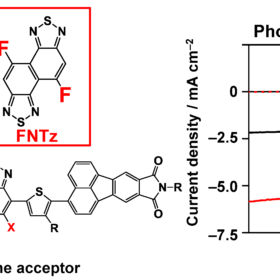
Fluorinated electron-acceptor improves yield of organic thin film solar cells
A Japanese research team claims to have tailored an electron-accepting unit, which has been successfully used in an organic semiconductor applied in a solar cell device that showed high PV performance.

‘There is no alternative to a world of 100% renewables’
Electrifying the global energy system with clean energy is the only way to reach the targets set by the Paris agreement on climate change and avoid the catastrophic scenarios outlined by the recent IPCC report. In an interview with pv magazine, Christian Breyer – Professor of Solar Economy at Finland’s Lappeenranta University of Technology – explains a 100% renewables model is not only technically feasible, but also the cheapest and safest option. With solar and storage at its core, the future energy system envisaged by Breyer and his team will not only stop coal, but also nuclear and fossil gas, while seeing solar reach a share of around 70% of power consumption by 2050. By that time, PV technology could cost a third of its current price.
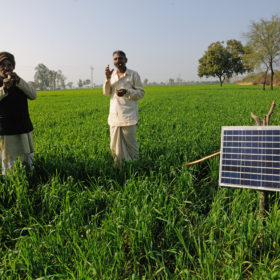
Rural India offers a $50bn opportunity for clean energy innovations
The farming sector alone offers a potential $40bn marketplace, thanks to rice transplanting, pesticide spraying and grain harvesting – says the Council on Energy, Environment and Water thinktank.
Solar panel theoretical efficiency limit increases by 33%
Researchers at the University of Amsterdam have found what they describe conclusive evidence that perovskites feature “efficient carrier multiplication,” effectively increasing the single layer efficiency limit from 33% to 44%.
