
‘There is no alternative to a world of 100% renewables’
Electrifying the global energy system with clean energy is the only way to reach the targets set by the Paris agreement on climate change and avoid the catastrophic scenarios outlined by the recent IPCC report. In an interview with pv magazine, Christian Breyer – Professor of Solar Economy at Finland’s Lappeenranta University of Technology – explains a 100% renewables model is not only technically feasible, but also the cheapest and safest option. With solar and storage at its core, the future energy system envisaged by Breyer and his team will not only stop coal, but also nuclear and fossil gas, while seeing solar reach a share of around 70% of power consumption by 2050. By that time, PV technology could cost a third of its current price.

Rural India offers a $50bn opportunity for clean energy innovations
The farming sector alone offers a potential $40bn marketplace, thanks to rice transplanting, pesticide spraying and grain harvesting – says the Council on Energy, Environment and Water thinktank.
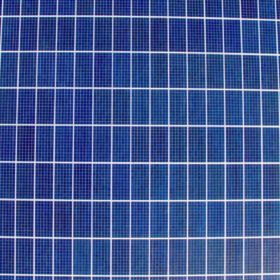
Solar panel theoretical efficiency limit increases by 33%
Researchers at the University of Amsterdam have found what they describe conclusive evidence that perovskites feature “efficient carrier multiplication,” effectively increasing the single layer efficiency limit from 33% to 44%.

Meyer Burger to lay off 100 workers and relocate most of PV business to Asia
There may be a much-vaunted ‘solar renaissance’ in the offing for Europe, but it hasn’t come quickly enough for the Swiss PV equipment supplier, which wants to handle most of its sales and services from China.
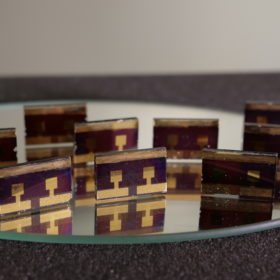
Swiss research group develops methylammonium-free perovskite cells
The organic methylammonium (MA) molecules in the cell were replaced with inorganic elements such as rubidium and cesium. The planar perovskite cells resulting from the research have an efficiency of more than 20%.
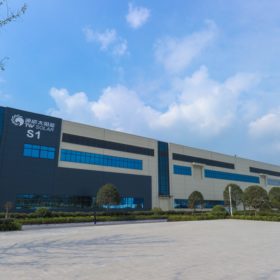
China’s Tongwei ramping up solar research and development
Heterojunction and TOPcon cell technologies being explored by Hefei-based cell and module maker. The Chinese giant is also preparing to fly in the face of predictions the big players will curtail plans to expand production after this year’s policy developments in their homeland.

Solaredge charges into storage market, acquiring Kokam
The inverter maker will buy 75% of Kokam’s shares for $88 million, with an intent to acquire the remainder shortly after, on the open market. Strategic company acquisitions and close partnerships are characterizing this year’s inverter market, as companies seek to diversify and integrate storage systems and other technologies.
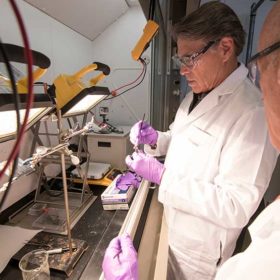
American scientists give PV a paint job
Berkeley researchers have discovered a shade of blue – dating back to ancient Egypt – which has impressive qualities they say could reduce building energy consumption and boost solar energy output. Meanwhile, the US National Renewable Energy Laboratory has developed a perovskite cell material that could be applied to a substrate using a paintbrush.
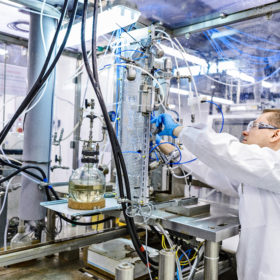
Innolith launches non-flammable battery with 50,000 charging cycles
Inorganic electrolytes will do the trick the company says. For multi-MW grid-scale applications the company says its technology can boost battery life to 50,000 cycles and is non-flammable. It adds that the costs of the product are competitive with conventional battery systems. Innolith is taking over the baton from Alevo, including chief executive and engineers. Alevo, however, went bankrupt last year, making the same promises.

TOPCon: The next big thing after PERC
TOPCon technologies could further increase solar cell efficiencies, said Guangyao Jin, chief scientist, DuPont Photovoltaic Solutions, at this year’s Energy Taiwan, held in September. He added that metallization paste is crucial.
