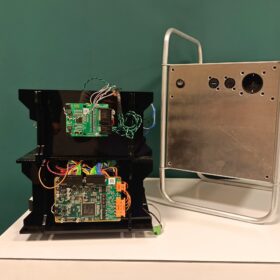
New partnership advances sodium-ion manufacturing in Spain
In a week marked by the largest sodium-ion battery order to date, widely seen as a watershed moment for the technology’s commercialization at scale, one of Europe’s emerging players, Spain’s Bihar Batteries, is strengthening the outlook for European-made sodium-ion batteries.

Resisting rust in solar
Over a 30-year asset life, corrosion can evolve into a structural, electrical, and fire safety issue. Corrosion drives up operations and maintenance (O&M) costs, reduces resilience to extreme events, and in some cases, can force premature decommissioning or complete structural replacement Intertek CEA’s Nicholas Hudson and Ankil Sanghvi advise on best practices.
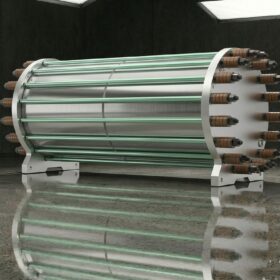
RCT Hydrogen begins manufacturing operations at German electrolyzer factory
RCT Hydrogen has launched operations at a new electrolyzer manufacturing facility in Saarbrücken, Germany, with planned annual production capacity of 250 MW and a first 5 MW system scheduled for assembly in 2026.
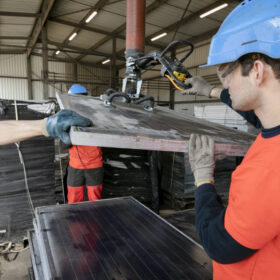
Rosi to build PV module recycling plant in Spain
Rosi has raised more than €20 million in a Series B funding round to scale its photovoltaic module recycling business and build a new 10,000-tonne-per-year facility in Teruel, Spain. The company uses pyrolysis-based technology to recover high-purity materials including silver, silicon, copper, aluminium and glass from end-of-life solar modules.
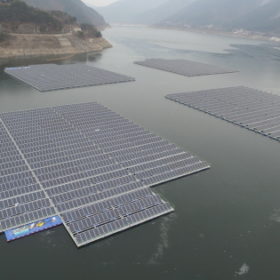
South Korea plans 3 GW of reservoir floating solar by 2030
Korea Rural Community Corp. (KRC) says it plans to increase floating solar capacity on agricultural reservoirs to 3 GW by 2030, from 105 MW currently in operation.
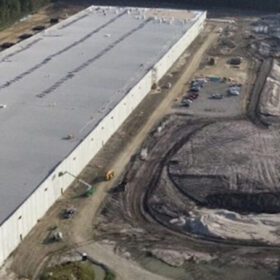
Boviet Solar sells U.S. PV module factory to Indian manufacturer Inox Solar
The divestment, already partially secured via escrow, reflects regulatory pressure from U.S. FEOC policy changes. Boviet Solar also continues negotiations to sell a separate U.S. cell project.
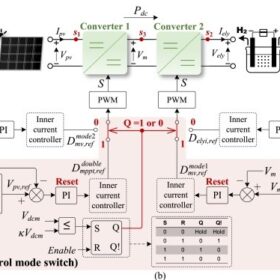
Low-power ride-through tech keeps green hydrogen flowing in standalone PV–electrolyzers
A UNSW-led research team proposed two low-power ride-through strategies for standalone PV–electrolyzer systems to maintain stability during sudden solar power fluctuations without using battery storage.

Indium oxide promises to increase CIS solar cell efficiency to unprecedented levels
Indian scientists developed a cadmium-free CIS thin-film solar cell using indium oxide as an electron transport layer, achieving a simulated efficiency of 29.79% with SCAPS-1D modeling. Through sensitivity analysis, they showed that low defect density, optimized absorber thickness, and effective thermal management are critical for minimizing recombination losses and enabling high-performance, scalable devices.

Installed BESS capacity in Spain grew by 589% since 2025 blackout
Some of the consequences of the blackout include a 589% increase in installed BESS capacity in Spain between April 2025 and April 2026, the introduction of renewable participation in voltage control, a greater role for gas in the generation mix, and continued progress on interconnections.

India launches 500 MW renewables tender requiring dispatch via power exchanges
Solar Energy Corporation of India has invited proposals to set up interstate transmission system (ISTS)-connected renewable energy projects for assured peak power supply of 1,500 MWh (500 MW for three hours) under a contract-for-difference (CfD) mechanism.
