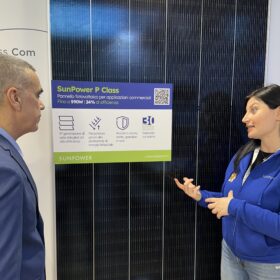
TCL Sunpower presents shingle TOPCon solar panels for rooftop PV
The Chinese manufacturer expanded its P Class portfolio with two new shingled-module series for residential and commercial rooftop installations. Both lines feature high-density, multi-busbar shingled cells for improved shade tolerance and long-term reliability with 30-year warranties.
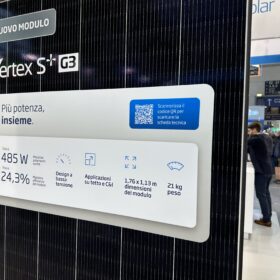
Trina Solar unveils 485 W TOPCon PV panel with 24.3% efficiency
The Chinese manufacturer has launched its third-generation Vertex S+ G3 dual-glass TOPCon modules for residential and commercial applications. The new products feature upgraded module architecture and a temperature coefficient if -0.26% per C.

London Underground inks private-wire solar deal with SSE Energy Solutions
Transport for London on track to receive 65,000 MWh of electricity per year from solar connected directly to one of Europe’s largest private power networks.

EU opens third cross-border solar tender
The EU’s third cross-border solar tender is offering a share of €54.9 million ($63.8 million) to solar-plus-storage projects in selected Bulgarian districts and ground-mounted solar projects in Finland, with funding provided by Luxembourg. The deadline for applications is September 1.
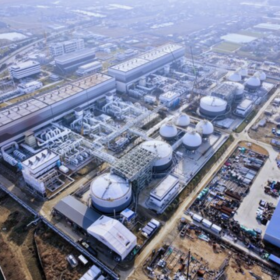
China’s 600 MW/2.4 GWh storage plant becomes world’s largest CAES site
With 600 MW of installed capacity and 2,400 MWh of storage, the Huai’an Salt Cavern project is now the world’s largest compressed air energy storage (CAES) facility, surpassing the 300 MW/1,500 MWh project commissioned earlier this year that previously held the title.
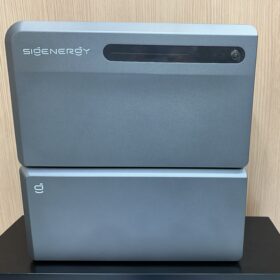
Sigenergy unveils 2.68 kWh battery for balcony PV
Sigenergy has launched a 2.68 kWh balcony storage system with four MPPTs and up to 4 kW of PV input. The scalable LFP solution offers 800 W grid output, 1.2 kW backup power, and expansion up to 18 kWh per tower.

Greece faces rising renewables curtailment, driving solar-plus-storage
Greece’s solar producers are facing rising curtailments that are cutting revenues and driving interest in energy storage, even as regulatory and financing challenges slow deployment.
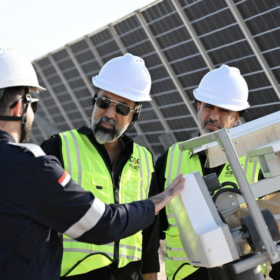
Iraq’s largest solar project enters trial operation
Iraq’s Ministry of Electricity says an initial 61 MW from the first unit of a planned 1 GW solar project has commenced. The project is being developed across four 250 MW units, with final commissioning currently scheduled for 2028.
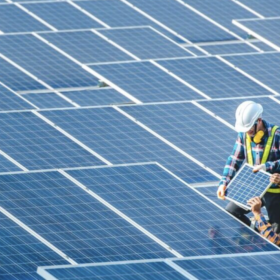
Germany’s Texxecure launches standardized quality rating for PV systems
The Texxecure PV Quality Rating evaluates solar modules, inverters, and entire projects using uniform technical criteria, condensing technical risk into a single AAA-to-D score for developers, investors, banks, and insurers.
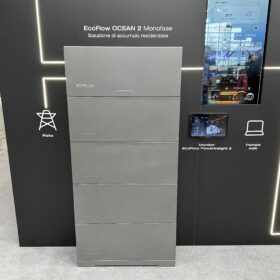
Ecoflow debuts 5 kWh residential inverter battery with 100% depth of discharge
EcoFlow has unveiled the single-phase Ocean 2 all-in-one battery inverter at Key Energy in Rimini. The system features a more compact 5 kWh LFP battery stackable up to 30 kWh and offering 100% depth of discharge, 3.4 kW discharge power, and IP66 protection.
