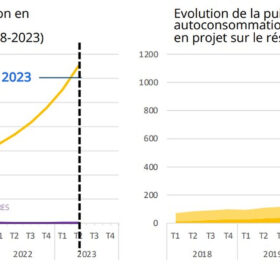
Solar self-consumption nearing gigawatt threshold in France
The latest figures from French grid operator Enedis for the connection of new PV systems under France’s solar self-consumption scheme reveal significant market growth in the first half of 2023.

Training deep machine learning to identify PV, solar thermal systems in aerial images
A Swedish research group has found that using deep machine learning to identify solar energy systems in aerial images may not be so accurate in non-densely populated countries such as Sweden. They have also found, however, that this technique may be trained via an iterative process and achieve satisfying results.

Triple junction perovskite-perovskite-silicon solar cell with open-circuit voltage of over 2.8 V
Scientists at Germany’s Fraunhofer ISE have designed a triple-junction solar cell consisting of perovskite-perovskite-silicon subcells. The device reportedly achieves an efficiency of 20.1% and a remarkable open-circuit voltage of over 2.8 V.

China’s Gotion launches battery production in Germany
Gotion High-Tech has started making battery packs at its 20 GWh automated plant in Göttingen, Germany. It expects deliveries to clients in Europe to commence in October.
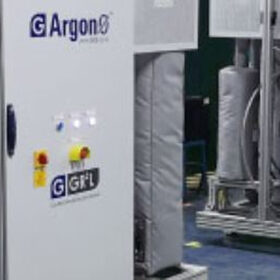
UK firm to supply argon recycling tech for 2 GW of solar in India
Gas Recovery and Recycle Ltd. (GR2L) has revealed plans to supply its ArgonØ machinery for 2 GW of solar capacity in India. Its ArgonØ tech can recycle up to 95% of the argon used in the fabrication of silicon wafers for solar panels.
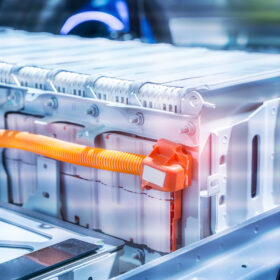
The Battery Cycle part two: Device lifespan
Having discussed battery chemistry in a previous article, Volytica diagnostics here examines the causes of battery degradation and how to extend device lifetimes, ahead of a pv magazine webinar tomorrow.
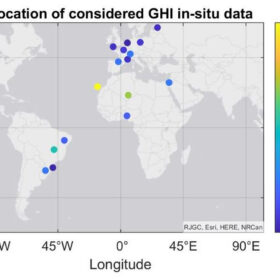
Benchmarks for solar energy data, methods
The lower the uncertainty in solar resource data, the lower the investment costs. IEA PVPS Task 16 has organized and published two benchmarks to make uncertainty of models and data comparable – a first important step. The benchmarks included modeled solar resource data and methods to fill gaps in measurements.

Infrastructure reform is key to accelerating Africa’s energy transition
In its latestt monthly column for pv magazine, the International Renewable Energy Agency explains that, in order to realize Africa’s vast potential, we must ensure there is adequate investment and infrastructure development to support renewable energy. In the coming years, this means urgently overcoming the structural barriers across three priorities: infrastructure, policy, and institutional capabilities.
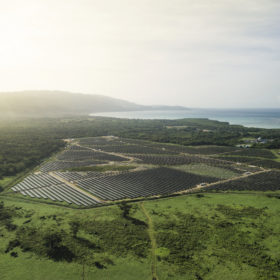
Jamaica seeks proposals for 100 MW of renewables
The Jamaican government is seeking 100 MW of renewables to diversify its energy grid, with independent power producers to generate this capacity through wind, solar, and hydro projects recommended under power purchase agreements (PPAs), according to tender documents.

Indian scientists making high-purity polysilicon ingots from recyled PV cells
Indian scientists have produced high-purity polysilicon ingots from recycled solar cells using “spark plasma sintering” (SPS), and claim they may achieve a purity level comparable to commercially available products.
