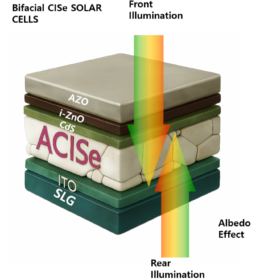
Scientists build bifacial CIS solar cell with record efficiency, power density
Researchers in South Korea have demonstrated a lower temperature process for bifacial copper, indium, selenium (CuInSe₂) solar cells with a rear-side efficiency of 8.44% and 15.30% on the front. The device has been developed for applications in tandem solar cells.

Researchers highlight importance of site-specific agrivoltaics design
A research team from Temple University in Philadelphia analyzed the synergies and trade-offs of land conversion to agrivoltaics and other multi-use solar energy landscapes globally. They found that co-located solar systems should be specifically tailored in order to offer optimal performance and minimize negative impacts.

Ivory Coast to build 52 MW solar plant by 2027
Ivorian developer Tongon Solaire has signed an agreement with the government of Ivory Coast for a 52 MW solar plant. The project is set for commissioning before the end of 2027.
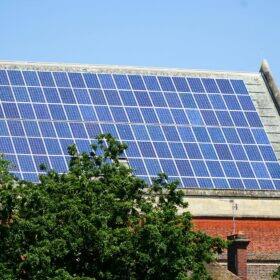
France publishes bidding terms for new commercial solar tenders
France has published updated bidding terms for commercial and industrial (C&I) solar tenders, with 192 MW of capacity available in the first round from Sept. 22 to Oct. 2, 2025 – a sharp drop from previous development levels.
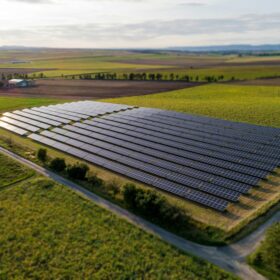
UK opens seventh CfD renewables auction
Extended contracts and more flexible commissioning dates on offer for solar developers. The target commissioning window for solar projects has also been extended, giving developers more flexibility on contract start dates.
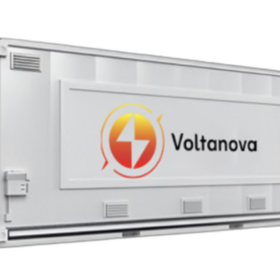
Thermal batteries offer alternative to lithium-ion storage
Jaicky Kumar, co-founder and CEO of Voltanova – a deep-tech firm incubated by the Foundation for Science, Innovation and Development (FSID) at the Indian Institute of Science (IISc) – speaks to pv magazine about the company’s thermal battery system and how it compares to lithium-based energy storage.

Senegal switches on inaugural solar-plus-storage facility
Africa REN has commissioned a 16 MW solar plant with 10 MW/20 MWh of battery storage in northern Senegal, billed as the first grid-connected solar-plus-storage facility in West Africa.
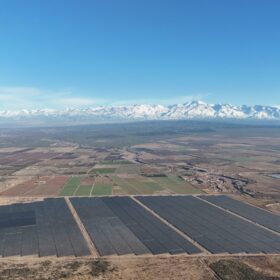
Genneia switches on 180 MW solar park in Argentina
Argentina’s Genneia has begun commercial operations at the 180 MW Anchoris solar park in Mendoza province, a $160 million project aimed at supplying large industrial consumers through the country’s Renewable Energy Futures Market.
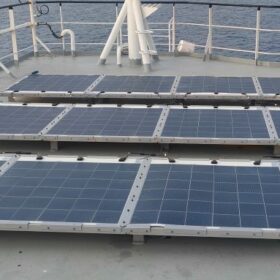
Glass-free PV modules tested on bulk cargo ships
Japan’s Eco Marine Power announced a trial of an integrated solar PV system aboard a bulk cargo ship to demonstrate both practicality and performance. It features glass-free monocrystalline silicon modules from U.S.-based Merlin Solar Technologies.
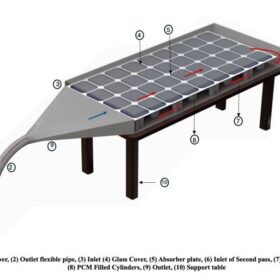
Photovoltaic-thermal solar air heater based on PCM cylinders, air convection
Researchers in Malaysia designed a photovoltaic-thermal system that can be used in solar drying, space heating, rooftop systems, and off-grid thermal applications. It relies on a double-pass cooling technique based on air convection and phase change material that can reportedly increase PV efficiency from 7% to 9% and thermal efficiency by 31.45%.
