Chinese PV Industry Brief: New EVA encapsulant factory, 1 GW PV pipeline
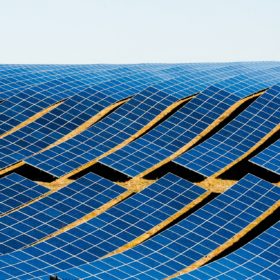
Cybrid, a Shanghai-listed backsheet supplier, will open a new EVA encapsulant factory in Zhejiang province. Datang, meanwhile, has revealed plans to build 1.05 GW at 10 sites across three provinces.
A cell so thin, it can rest on a soap bubble
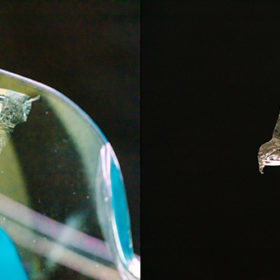
Scientists at Saudia Arabia’s King Abdullah University of Science and Technology demonstrated an organic PV cell that can simply be printed onto a piece of paper. The cell set a new efficiency record for a fully inkjet-printed device, and its designers envisage applications in integrated medical sensors.
Light and shade of 500 W plus solar panels – part II
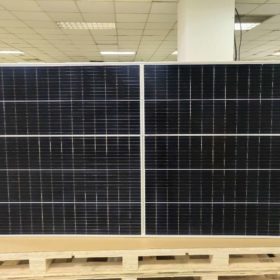
In the second article in a series, pv magazine editor Pilar Sánchez Molina and industry experts keep discussing the challenges and opportunities created by new panels with power output exceeding 500 W.
Solar projects enable biodiversity
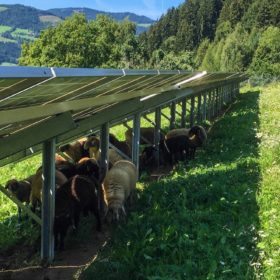
Eco-Tec, an Austrian PV company, is cooperating with a startup, Meine Blumenwiese, to ecologically upgrade ground-mounted solar projects. The two companies aim to generate clean energy while also creating new habitats for a range of insects and animals.

Niger holds firm on plan to build solar park at diesel-fueled thermal plant
The solar plant is expected to have a capacity of up to 60 MW and will be located at the 100 MW Gorou Banda thermal power station commissioned in 2017.

Computational method shows Italy may install 144.5 GW of PV by 2050
According to a new study, PV may reach an installed power of 144.5 GW in Italy by the end of the first half of the century, followed by onshore and offshore wind with 59.6 GW and 17.6 GW, respectively. The research is based on a new computational model that identifies the best spatial distribution of renewable energy sources in an individual country or electricity system while avoiding problematic concentrations of technologies
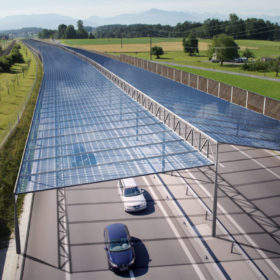
Photovoltaics for highways
The Austrian Institute of Technology, Fraunhofer ISE, and Forster Industrietechnik are developing a new rooftop PV system concept for motorways. They aim to harness the potential of underexploited road networks to generate electricity.

Scaling up solar manufacturing in India
A new study by the CEEW Centre for Energy Finance assesses China’s advantages over India, but presents ways for the South Asian nation to build a competitive PV manufacturing sector.
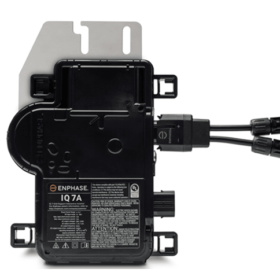
Enphase microinverters for high-power modules
The US microinverter manufacturer has now brought its inverter solution for commercial and industrial solar to Australia and Europe. The device is suitable for modules with power output ranging from 295 to 450 W and has a European efficiency of 96.5%.

Light and shade of 500 W plus solar panels – part I
In the first article of a series, pv magazine editor Pilar Sánchez Molina analyzes with industry experts challenges and opportunities created by new panels with power output exceeding 500 W.
