
Power Ledger enables consumer participation in energy markets
Australian startup Power Ledger wants to scale up its offerings for much larger communities, as it has already verified its technologies in projects around the world. The Australian Energy Market Commission last week proposed a similar agenda.
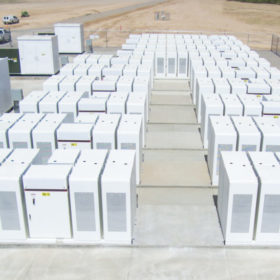
Salt River Project joins big boys of battery storage
The Salt River Project has announced a 250 MW, 1,000 MWh battery project in Little Rainbow Valley, Arizona. The installation will be the largest in the state and among the largest in the United States.
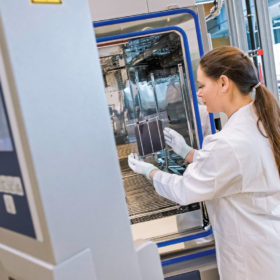
The weekend read: A responsible compromise?
Toxicologists are struggling to follow the pace at which perovskite solar cells race from laboratory test benches to factory production lines. While researchers continue to assess the health and safety risks stemming from the lead used at the core of these new materials, the startups commercializing them argue that established encapsulation techniques and sound recycling schemes are enough to safety-proof their potentially disruptive technology and offset broader environmental threats.

Jordan renews solar rebates for residential PV
The Kingdom of Jordan’s government has signed an agreement with Jordan Islamic Bank to facilitate the financing of residential projects under the scheme. Selected projects will be entitled to a 30% rebate for installations up to 3.5 kW.
Troubled Indian manufacturing-linked solar tender now reportedly oversubscribed
A series of new amendments by the Solar Energy Corporation of India appear to have paid off, as the organization’s ambitious manufacturing-linked solar tender has reportedly ended up oversubscribed by 1 GW – of the capacity offered as an incentive at least.
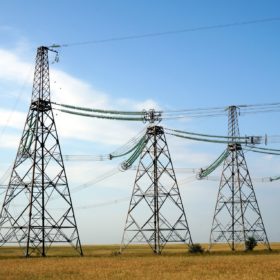
China’s nuclear operator to develop 1 GW solar field
China General Nuclear Power Group is reportedly preparing to invest almost $2.5 billion into a huge solar project – plus 2 GW of wind turbines – in the autonomous province of Inner Mongolia. Local authorities say the massive project will be complete in 2021.

British capacity market row continues over £1 billion payment insecurities
The bickering around the British Capacity Market is not over yet. The European Commission has closed its formal investigation into the market mechanism’s alleged violation of EU State Aid rules, finding no violations of that kind. But footing the bill for the year-long suspension of the scheme might prove complicated.

International research group claims 8.8% efficiency for amorphous solar cell
The new cell is based on a p-type transparent conductor made of carbon nanotube fibers. The device is said to offer 16% more efficiency than rival amorphous cells.
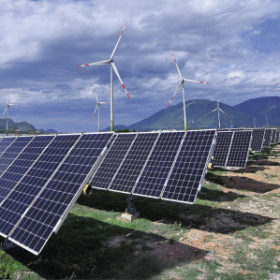
A new converter topology for hybrid wind-solar
A researcher has proposed a new approach to apply maximum power point tracking techniques to optimize electricity production in wind-solar power projects. The permanent magnetic synchronous generator hybrid model used in the study is based on a multi-input rectifier stage which is said to be able to eradicate current harmonics and eliminate the need for extra input filters.

Organic dopants for a stable perovskite
Researchers at Saudi Arabia’s King Abdullah University of Science and Technology have demonstrated a method they say could improve the stability of perovskite structures. The group found adding an organic dopant served to increase the strength of chemical bonds between organic and inorganic elements of a perovskite.
