
China tightens carbon accountability framework, strengthening structural push for renewables
Beijing has introduced a stricter national carbon evaluation system that formally holds provincial governments accountable for emissions reduction and energy transition targets.

Cooling PV modules with hydrogel-coated paper
A Vietnamese research team has developed a low-cost passive cooling system for PV modules based on hydrogel-coated paper that combines water flow and interfacial evaporation to reduce operating temperatures. Outdoor tests showed temperature reductions of up to 14 C and efficiency gains of up to 16.8%, with stable operation achieved using both freshwater and natural seawater.
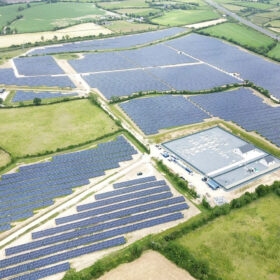
Ireland’s grid-scale solar breaches 1 GW generation mark
Grid-scale solar PV electricity generation surpassed 1 GW in mid-April, which marked a new record in Ireland according to the country’s high-voltage transmission system operator Eirgrid. Around 500,000 customers’ power needs can be met with 1 GW, Eirgrid estimates.

How to electrify greenhouses with semi-transparent PV, heat pumps
Researchers in Canada found that 69%-transparent crystalline silicon semitransparent PV modules can improve tomato greenhouse yields by up to 38% while maintaining healthy plant growth through beneficial partial shading. Their simulations also showed that combining rooftop agrivoltaics with heat pumps can fully eliminate fossil fuel heating.

CATL raises $5 billion in share sale, Sungrow files for Hong Kong IPO for the second time
CATL has completed a roughly $5 billion share sale in Hong Kong on Tuesday. Meanwhile, Chinese inverter and battery manufacturing giant Sungrow is making a second attempt at an IPO after its initial listing bid, launched in October 2025, lapsed.

Bangladesh launches 495 MW solar tender
BPDB has launched a tender for 495 MW of grid-tied solar power projects across 10 sites in Bangladesh, with capacities ranging from 25–100 MW and full private investment required. The bid structure, which places land acquisition and financing risks on developers, has drawn investor concerns over bankability and limited project attractiveness.
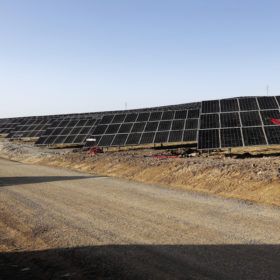
Cox buys Iberdrola Mexico for $4 billion
Cox has acquired Iberdrola México for $4 billion, adding 2,600 MW of capacity and becoming Mexico’s largest private power supplier with a 12 GW renewable project pipeline.

China commissions salt cavern hydrogen storage project
China’s first large-scale salt cavern hydrogen storage demonstration project has been commissioned in Henan province. The 1.5 million m³ facility validates geological hydrogen storage technology and supports renewable energy integration.
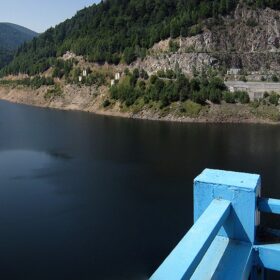
Bulgaria seeks to revive 864 MW Chaira pumped-storage hydropower plant
Supported by Toshiba, Bulgarian utility NEK is working to restart its 864 MW Chaira pumped-storage hydropower plant, the largest of its kind in Southeastern Europe. The facility has been offline since March 2022 following a turbine failure.

Longi announces world record efficiency of 28.13% for silicon solar cell
Longi claims to have achieved the world’s highest efficiency for a silicon solar cell. The result was confirmed by Germany’s Institute for Solar Energy Research Hamelin (ISFH).
