
Malaysia restricts non-AI data centers, citing energy concerns
Malaysia’s prime minister Anwar Ibrahim said future policy will ensure domestic consumers and the electricity grid are protected amid the country’s data center expansion. This could include leveraging the ASEAN Power Grid project to cover any supply shortfalls.

AlphaESS releases containerized C&I storage system
The Chinese manufacturer said its Aster TB250/TB500 system is compatible with both 40 0V and 800 V PV systems. Parallel connection allows scaling up to 3 MW / 8.46 MWh.
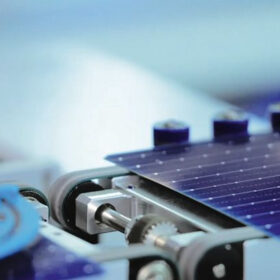
JinkoSolar achieves record-breaking 26.66% efficiency for TOPCon solar cell based on M10-size wafer
The Chinese manufacturer claims the new efficiency result sets a world record for industrial-scale TOPCon solar cells on M10-size wafers. The achievement was verified by an undisclosed independent third-party organization in China.
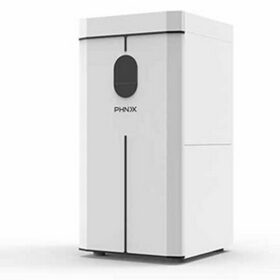
Phnix unveils indoor monobloc heat pump for space‑constrained urban retrofits
The Chinese manufacturer said its new airMono indoor monoblock heat pump is tailored for space‑limited urban retrofits, providing heating, cooling, and domestic hot water without an outdoor unit. The system’s coefficient of performance ranges from 2.5 to 4.1, while the seasonal coefficient of performance spans 4.5 to 4.7.
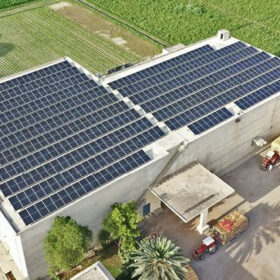
Pakistan blocks retroactive export rate cut in net billing shift
Late amendment put forward to halt sudden retroactive change to export rates for net metering contract holders in Pakistan. It follows strong criticism from local solar industry leaders over sudden change in export rates under new net billing structure.
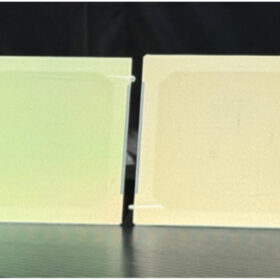
Japanese scientists build near-white heterojunction solar cell for BIPV applications
The lab-scale, near-white heterojunction solar cell uses nanoclay-based scattering layers combined with dielectric multilayer films to preserve power conversion efficiency while enhancing visual appeal. The researchers report optical losses of less than 1% at a 50% clay volume fraction, which are significantly lower than those observed with textured glass.

U.S government sets preliminary countervailing duties on solar imports from India, Indonesia and Laos
The U.S. Department of Commerce has issued preliminary findings that solar manufacturers in India, Indonesia and Laos benefited from government subsidies, paving the way for countervailing duties of up to 143.30%.

South Korea to invest $223 million in next-generation distributed grid
The South Korean government has announced plans to invest KRW 321 billion ($222.6 million) in 2026 to upgrade regional distribution networks, deploy 85 energy storage systems, and expand solar integration while piloting microgrids and market reforms.
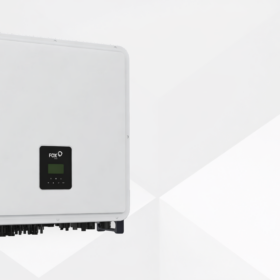
Fox ESS releases hybrid inverters for commercial PV
The inverters offer up to 99.2% efficiency, 200% PV oversizing, dual battery inputs, IP65 protection, and support for installations up to 144 kWh of storage capacity.

Taiwan’s solar feed-in tariffs remain unchanged
The Taiwanese authorities have also introduced a repowering mechanism designed to encourage replacement of aging PV equipment.
