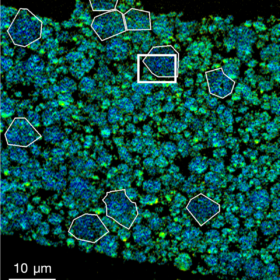
Hold your breath for a better battery
Recent research has revealed a previously underestimated role for oxygen in limiting the performance of lithium-ion batteries. Newly published research from both Japan and the United States has sought to look deeper into the chemical reactions at the heart of lithium-ion storage; and to better characterize the cumulative effects that minuscule amounts of oxygen released during these reactions can have on battery performance and safety.

China opens ‘world’s biggest carbon market’
With the nation having operated seven pilot programs since 2011, a national scheme started trading on Friday, although the first day’s average carbon price of around €6.70 per ton of emissions was significantly below the €50/ton levels currently being seen in Europe.

Indian manufacturer to build 1.2 GW of mono PERC module capacity
Rayzon Solar, a Gujarat-based PV manufacturer, is scaling its production lines up to 1.5 GW with the addition of 1.2 GW of mono PERC output capacity by the end of December. The new line will produce 600 Wp panels with efficiency ratings of 21.4%.

Solar module for floating PV from Hyundai
The bifacial panel has a power output of up to 485 W and an efficiency of up to 21%. It relies on a transparent backsheet and is encapsulated with polyolefin elastomer (POE).
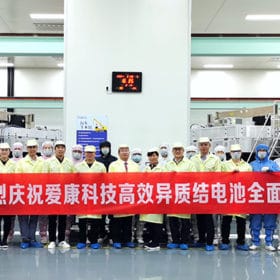
Chinese PV Industry Brief: Mixed financial results for wafer and module makers
Preliminary results were published for Solargiga, Zhonghuan Semiconductor, GCL System Integration, JYT Corporation and Akcome Tech.
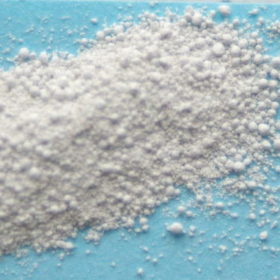
Chemical bath deposition for 21.7%-efficient perovskite solar cell based on tin oxide films
The cell was used to build two perovskite solar modules with a size of 5x5cm and 10x10cm, respectively, and with efficiencies of 15.62% and 11.80%.
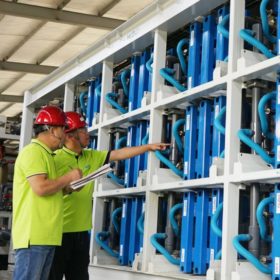
China wants to test vanadium redox flow batteries
A 125 kW/500kWh storage unit will be tested by China’s National Photovoltaic and Energy Demonstration Experimental Center. The storage system will be provided by Canadian specialist VRB Energy.
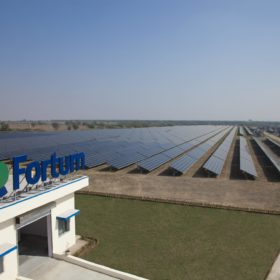
India tenders 1.2 GW solar in Karnataka
Solar Energy Corp. of India has given developers until Sept. 3 to bid for 1.2 GW of solar projects that will be set up on a build-own-operate basis in the state of Karnataka.

TSEC switches on new 500 MW solar cell production line
The new production line will enable the Taiwan-based manufacturer to produce larger and more powerful modules.

Nanocomposite films for 13.57%-efficient organic solar cell
Scientists in Malaysia have used, for the first time, nanocomposite films based on zinc oxide and polyvinyl alcohol in organic solar cells. These films were able to improve the efficiencies of the PV devices by up to 3.5%.
