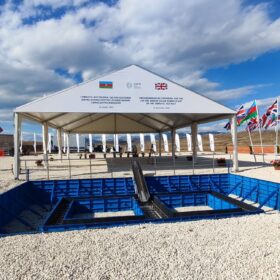
Azerbaijan breaks ground on 240 MW solar plant
Work is underway on a 240 MW solar project in southwestern Azerbaijan following the signing of an investment agreement and land lease agreement. It is being developed under an executive agreement between the Azerbaijan Ministry of Energy and energy giant BP.

EBRD, EU finance 126 MW solar plant in Uzbekistan
The European Bank for Reconstruction and Development (EBRD) and the European Union are investing a combined $61.6 million in a 126 MW solar project in Uzbekistan. A special-purpose company fully owned by French developer Voltalia will develop the plant.

Metrel launches electrical installation safety tester for PV systems
Metrel, a Slovenian measurement equipment supplier, says its new electrical installation safety tester can assess systems with a maximum voltage of up to 1,500 V and a maximum short circuit current of 40 A.
Sunly starts construction of three solar parks in Latvia
Estonian renewable energy company Sunly is building three solar parks in Latvia with a cumulative capacity of 225 MW. The projects are being developed as hybrid parks, combining solar with wind and battery energy storage.
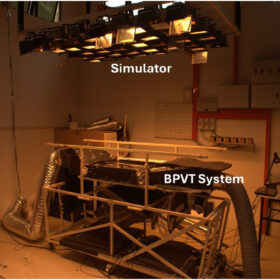
Cooling bifacial PV thermal solar panels with jet impingement
Scientists created a model to study bifacial PV thermal (BPVT) solar panels using jet impingement and built an experimental setup to validate it. They achieved a thermal efficiency of 62.28%, while electrical efficiency peaked at 11.22%.

European team targets 20%-efficient perovskite modules using industrial processes
The LUMINOSITY project consortium aims to develop 20%-efficient metal halide perovskite prototype modules measuring over 900 cm², designed for a 20-year lifespan and compatibility with roll-to-roll (R2R) processing.

French asset manager Mirova invests €480 million in Austrian developer RP Global
The transaction, consisting of equity and convertible bonds, will cover Italy, Germany, France, Spain, Portugal, Poland and Croatia. RP Global aims to commission 2.5 GWp of renewable power in the next five years.

EBRD, European Investment Bank fund 99 MW of solar in Croatia
The European Bank for Reconstruction and Development (EBRD) and the European Investment Bank (EIB) are funding a 99 MW solar project in southwestern Croatia with a total investment of €62 million ($67.2 million). Construction will begin next year, and commissioning is set for 2026.
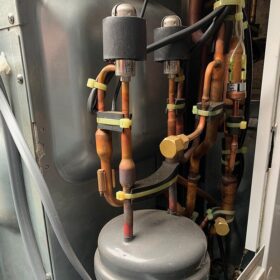
Climate data-based methodology for residential air-source heat pump sizing
A European research team proposed a new air-source heat pump sizing approach that utilizes long-term climate data and adjusts system operation based on actual local climate conditions. The sizing algorithm incorporates peak heat demand, unitary final energy demand, and seasonal heat demand across different house sizes.

Using texturized glass in building-integrated photovoltaics
Researchers from Poland have assessed how texturized glass used as the front cover of building-integrated photovoltaic panels affects performance. They have found power yield could be up to 5% lower compared to modules based on conventional glass, with reflection parameters being up to 88% in visible region.
