Romania’s grid operator publishes rules for capacity auctions
All generation and energy storage facilities of 5 MW or larger in Romania will be required to secure grid access via annual auctions beginning January 2026. The country’s transmission and system operator, Transelectrica, has published how it plans to implement the auctions.

Tender opens for supply, installation of solar systems in Ukraine
The United Nations Development Programme (UNDP) plans to establish a list of prequalified companies to bid for the future supply and installation of solar systems in Ukraine. The deadline to apply for the tender is Oct. 25.
Albania reviews 105 MW of new solar project applications
Albania’s Ministry of Infrastructure and Energy has received three proposals for solar parks totaling 105.6 MW, all without subsidies or concessions.

Permit secured for 270 MW solar-plus-storage project in Serbia
Türkiye’s Fortis Energy has secured a construction permit for 270 MW of solar alongside 72 MWh of battery energy storage to be built in northwestern Serbia. Construction is scheduled to begin during the second quarter of next year.
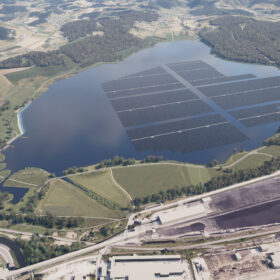
Slovenia plans 140 MW floating solar plant
Slovenian energy company HSE is developing a 140 MW floating solar project, with work currently underway on spatial planning activities. The solar plant is set to become Slovenia’s largest solar project and Europe’s largest floating solar array to date.

Czechia amends electricity generation licence threshold
An amendment to Czechia’s Energy Act has increased the limit for mandatory electricity generation licences from 50 kW to 100 kW. The change applies to solar installations that produce electricity for direct consumption.

Ukrainian city switches on solar arrays for local water utility
Solar systems with a combined capacity of 340 kW have been switched on at three water supply and wasterwater facilites in the west Ukrainian city of Chortkiv, designed to provide residents with uninterrupted water supply.

Optimum tilt angle for PV systems ranging from 0° to 90°
A Slovak research team has developed a mathematical model for determining the optimum tilt angle of a solar system ranging from 0° to 90°. Their framework was tested on an experimental setup in Czechia and attained 93.9% accuracy in predicting the system’s energy balance.

The Hydrogen Stream: Japanese researchers develop low-temperature hydrogen battery
Institute of Science Tokyo researchers proposed a battery with magnesium hydride (MgH2) as the anode and hydrogen (H2) gas as the cathode. Meanwhile, researchers at Chung-Ang University proposed chloride-resistant ruthenium (Ru)-based nanocatalysts for direct electrolysis and hydrogen production from seawater.

PV-powered thermal distillation device with self-cleaning, cooling
Scientists in Hungary have built a prototype of a thermal distillation device, supported by PV power. The PV panels use an IoT component that self-cleans when dust is detected and cools itself when the temperatures are too high. The system achieved a daily freshwater yield of 6.1 L/m2⋅day.
