
EU opens third cross-border solar tender
The EU’s third cross-border solar tender is offering a share of €54.9 million ($63.8 million) to solar-plus-storage projects in selected Bulgarian districts and ground-mounted solar projects in Finland, with funding provided by Luxembourg. The deadline for applications is September 1.

Estonia deploys 105 MW of solar in 2025
Estonia’s cumulative solar capacity reached around 1,430 MW by the end of last year. Year-on-year installations slowed as the country’s solar market begins to saturate, with future growth expected to be driven by supplementing solar parks with batteries.
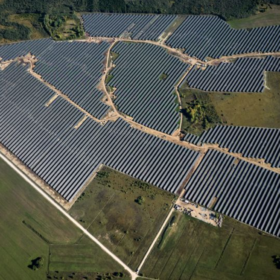
Estonia advances 1.1 GWh heat storage, 250 MWh BESS and 800 MWh battery park
Estonia has delivered its largest heat storage facility, begun construction on its largest solar-plus-storage hybrid project, and is preparing to break ground on an 800 MWh battery park in Valga County, set to become the largest in the Baltics.

100 MW Hertz 1 battery enters operation after Estonia–Finland grid incident
The 100 MW/200 MWh battery energy storage project in Kiisa began operation on Feb. 3 as scheduled – just two weeks after a testing fault at the facility caused the most significant disturbance to the regional power grid since Estonia’s desynchronization from the Russian electricity system.
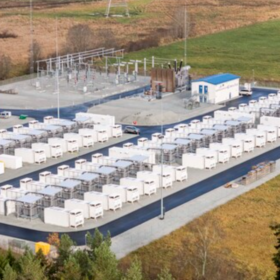
Testing fault at 100 MW battery disrupts Estonia-Finland power link
During testing at Estonia’s 100 MW Kiisa battery park, both EstLink 1 and EstLink 2 tripped, triggering the most severe disturbance to the regional power grid since desynchronization from the Russian electricity system. As a result, nearly 1 GW of capacity was lost within seconds. The park’s owner has since publicly pointed to the battery manufacturer.
The Hydrogen Stream EU funds eight hydrogen projects under NetZero call
The EU Innovation Fund has awarded €2.9 billion ($3.4 billion) to 61 projects, including eight advancing hydrogen technologies across aviation, shipping, and heavy transport.

The Hydrogen Stream: Japanese researchers develop low-temperature hydrogen battery
Institute of Science Tokyo researchers proposed a battery with magnesium hydride (MgH2) as the anode and hydrogen (H2) gas as the cathode. Meanwhile, researchers at Chung-Ang University proposed chloride-resistant ruthenium (Ru)-based nanocatalysts for direct electrolysis and hydrogen production from seawater.

Freen launches scalable sodium-ion battery storage
The Estonian home and commercial storage systems come in low- and high-voltage models. The high-voltage option can scale to ten modules, for 100.8 kWh, and a six-module, low-voltage version to 45 kWh.

Estonian solar park enters Baltic frequency markets
Eesti Energia and Emsys VPP have prequalified the 75 MW Sopi solar park to deliver 30 MW to the Baltic region’s automatic frequency market and 45 MW to its manual frequency market.

The Hydrogen Stream: Sungrow starts world’s largest dual-tech green H2 plant
Sungrow Hydrogen has started production at China’s largest dual-tech green hydrogen project combining PEM and alkaline electrolyzers, while HNO International has partnered with Zhuhai Topower to pilot its modular hydrogen platform in China.
