
Self-cleaning perovskite solar cell based on leek leaves-like film achieves 14.2% efficiency
Scientists in Finland have built a perovskite solar cell with a bio-inspired coating that reportedly improves light transmittance while providing self-cleaning properties. The film was able to improve the device efficiency by up to 6%.
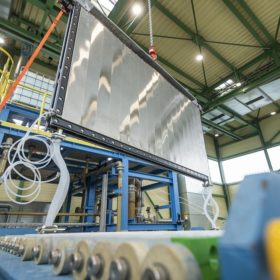
The Hydrogen Stream: thyssenkrupp nucera sees uncertainties in the medium term
Thyssenkrupp nucera warns of possible delays in hydrogen projects, with consequences for producers. Meanwhile, Shanghai Electric seems bullish about the market and its ability to drive costs down.

Germany’s Priogo files for insolvency
The photovoltaic installation company is struggling with the current difficult market situation. A solution for its continuation is now being sought.
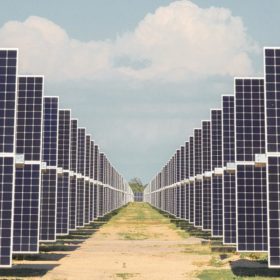
Spain approves construction of 24,870 MW of PV
These are 283 renewable projects for 28 GW, 66% of the 428 that started the process, and 70% after undergoing modifications to meet various conditions, particularly of an environmental nature.

Battery storage on a capacity market
In Germany – but not only there – there is a heated debate about the pros and cons of a capacity market. The German Renewable Energy Association is against it, and recently the German New Energy Industry Association, the DIHK and the EEX energy exchange have also taken a clear stance: Germany does not need a “power plant subsidy program.” In this article, four experts explain why battery storage can also play an important role in a capacity market and make recommendations on how the design of the market can help avoid mismanagement, wrong incentives and unnecessary costs.
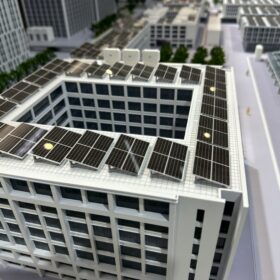
Smart buildings key to overcoming rooftop PV hurdles
In its latest monthly column for pv magazine, SolarPower Europe explains how several European countries are moving away from support schemes for injections and towards the adoption of time-variant supply tariffs, which play a crucial role in reducing daily price fluctuations. This shift challenges the traditional business case for rooftop PV, which often relies on maximizing grid injections.

Physical and virtual batteries for maximized self-consumption
French solar equipment supplier Monabee is expanding its range of solutions with two batteries – a physical and a virtual one, which can maximize the self-consumption of electricity produced by solar panels.

Iberdrola installs 80 kW PV system at Guggenheim Museum Bilbao
The solar array installed by Iberdrola consists of 300 FuturaSun solar panels, which have been chromatically integrated into the two largest roofs of the Frank Gehry building. The PV system will allow for annual self-consumption of 80 MWh.

Switzerland publishes database on alpine PV systems
The alpine-pv.ch platform is a joint project of four universities of applied sciences. Above all, it shows how much potential there is in alpine photovoltaic power plants to counter the looming winter electricity problem in Switzerland.
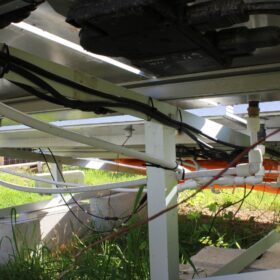
PV module cooling tech based on water chamber
Scientists in Malta have created an after-market cooling solution that can be fitted to existing standard PV modules. The system is based on a water chamber placed at the backside of the module and can reportedly provide a net electrical energy gain of more than 9%.
