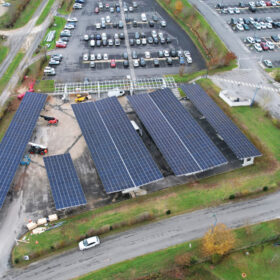
France extends collective self-consumption to 5 MW
After being exempted from excise duty up to 1 MW just over a month ago, the maximum power threshold for collective self-consumption has been raised from 3 MW to 5 MW in mainland France.
France sharply reduces PV targets in draft energy program
In the latest version of the draft Pluriannual Energy Program, photovoltaic targets have been revised downwards: For 2035, they have been reduced from the 75 GW to 100 GW range to 65 GW to 90 GW. For 2030, the target would be 54 GW, the low end of the 54 GW to 60 GW range submitted for consultation at the end of 2024.
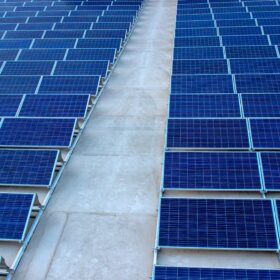
France concludes C&I rooftop PV tender with average price of €0.0982/kWh
The French authorities have concluded a commercial and industrial (C&I) rooftop PV tender with an average price of €0.0982 ($0.1067)/kWh. The government allocated 220 MW of PV capacity in total.
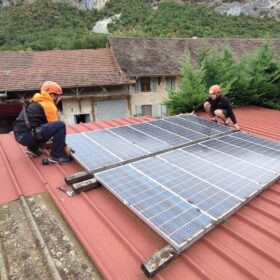
In France, future of small-scale solar power producers in limbo
Between the application of the reduced VAT and the retroactive reduction in solar subsidies, a delay of eight months could spell disaster for the small-scale self-consumption power plant sector. The GPPEP, which defends these individual producers, warns of the risks for households wishing to equip themselves, but also for those with already installed systems who could find themselves without a contact for maintenance or repair of their installations. pv magazine France spoke with Joël Mercy, president of the association.
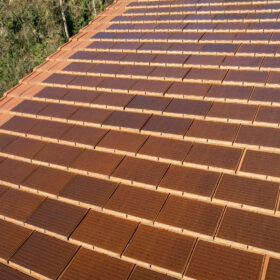
Edilians supplies France’s largest solar terracotta tile roof project
To respect the architectural harmony of the northern French commune of Rives-en-Seine, a municipal technical services building, located not far from a former 17th-century convent, underwent renovation work during which a 1,200 m2 roof of PV tiles was installed.
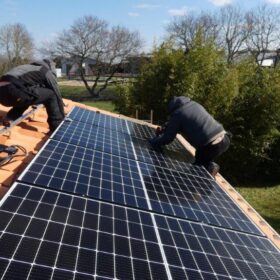
French self-consumption collective going against tide
A citizen’s collective in the western French seaside town of Les Sables d’Olonne has initiated a highly original self-consumption operation, seeking to bring together a majority of small-scale residential producers to supply local consumers.

Franco-German consortium uses satellite data for PV forecasting
A Franco-German consortium is launching the EO4ER project, which uses next-generation satellite data to anticipate the impact of variable solar generation on electricity grids. Through a digital twin prototype, it aims to refine intraday forecasts and integrate the effects of climate change on PV energy production.
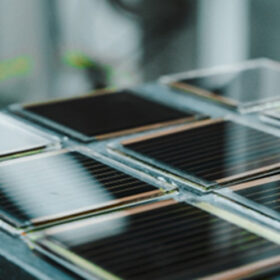
Chinese scientists build 20.3%-efficient mini inverted perovskite solar modules via slot die coating
A team led by University of Electronic Science and Technology of China (UESTC) has found that pyrrodiazole as an additive in formamidinium iodide (FAI)-based inverted perovskite solar enables larger area devices made with industry-compatible slot die coating. Modules made using the technology achieved 20.3% certified power conversion efficiency and retained 94% of initial efficiency after 1,000 h in standard testing.
Sécurité et optimisation du LCOE des grandes centrales photovoltaïques
Dans ce webinaire de pv magazine France, Sungrow et son partenaire Stäubli exploreront la manière dont les principales défaillances électriques peuvent être évitées, afin d’optimiser la production photovoltaïque des grands parcs solaires et le coût moyen de l’énergie (LCOE).

Exide releases mobile 200 kWh, 400 kWh storage solutions
The company said the new product uses up to four lithium iron phosphate (LFP) batteries. It is equipped with a single 180 kW or 2 x 90 kW chargers and multiple three-phase sockets.
