
French asset manager Mirova invests €480 million in Austrian developer RP Global
The transaction, consisting of equity and convertible bonds, will cover Italy, Germany, France, Spain, Portugal, Poland and Croatia. RP Global aims to commission 2.5 GWp of renewable power in the next five years.
German government funding for renewable energy expected tor each €18 billion in 2025
The costs for renewable energy funding this year will be higher than forecast, due in part to the many hours with negative spot market prices on the electricity exchange. A new report expects the trend of high costs to continue until 2029.

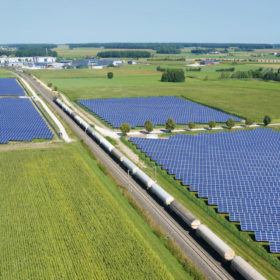
Around 40% of PV plants deployed in Germany are close to transport routes
A group of researchers have investigated the influence of the regulatory framework on supporting the expansion of ground-mounted PV plants close to transport routes as railways, highway and federal roads in Germany. Their analysis showed that most of the PV systems installed next to these routes are located on what was once agricultural land.
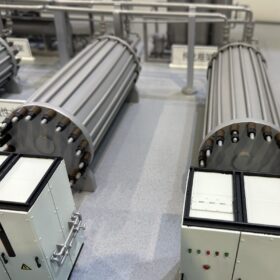
The Hydrogen Stream: Statkraft advances green H2 plans in Germany
Statkraft says it is progressing with its 200 MW electrolysis plant in Germany, while Neste says it will not invest in its 120 MW electrolyzer project in Finland.
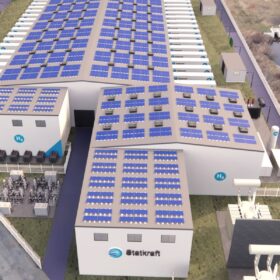
Statkraft aiming for up to €107 million in EU funding for hydrogen production in Germany
The Norwegian energy company wants to build 200 MW of electrolysis capacity in the German state of Lower Saxony. The waste heat generated is to be used for district heating. The EU has now asked Statkraft to enter into negotiations on funding.
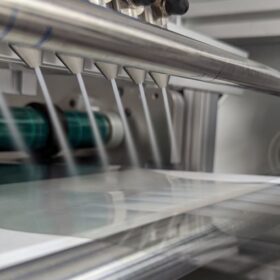
New cleaning tool for perovskite, organic PV roll-to-roll production equipment
A German research team has developed a precise cleaning process for electrode deburring in perovskite and organic solar PV roll-to-roll production lines. It is based on commercially available equipment from Germany-based Acp Systems.

‘TOPCon technology comes with three or four relevant risks that should be known’
The results of this year’s Kiwa PVEL scorecard have shown that TOPCon technology is more vulnerable than PERC, and the failure rate at BOM level has increased to 41%, the highest in history, according to the testing lab.
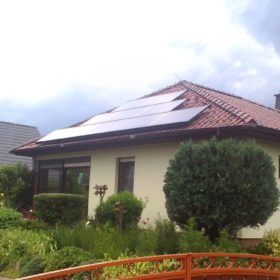
Residential PV prices in Germany drop 25% within 12 months
The comparison site Selfmade Energy shows, in addition to the falling prices, that customers are obtaining significantly more offers than they were one or two years ago. Managing director Tim Rosengart assumes that the price pressure on installers will continue in the coming months.
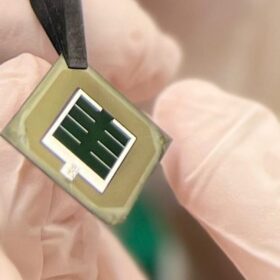
KAUST, Helmholtz-Zentrum Berlin present 31.2%-efficient blade-coated perovskite-silicon tandem solar cell
The perovskite-silicon tandem device has a two terminal configuration and a 2D perovskite layers at the bottom interface. It was able to retain around 80% of its initial efficiency for 1,700 h.
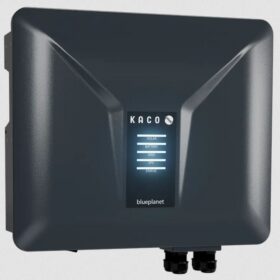
Kaco launches new hybrid inverters for residential applications
The German manufacturer unveiled a new line of hybrid inverters for applications ranging from residential rooftop arrays to projects on small commercial buildings. They have outputs between 6 kW and 12 kW, a maximum efficiency of 98.19%, and a maximum European efficiency of 96.55%.
