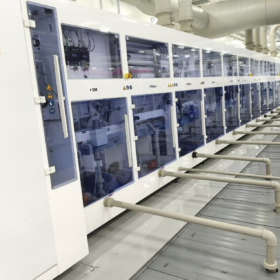
India approves solar cell makers with 13 GW of annual production capacity
India has approved six manufacturers for its Approved List of Models and Manufacturers (ALMM) for solar cells, totaling 13 GW of annual production capacity. The list includes FS India (First Solar’s India unit), Jupiter, Emmvee, Mundra (Adani), Premier Energies, and ReNew.
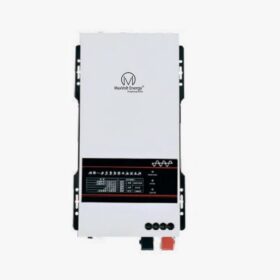
MaxVolt launches smart inverter with inbuilt lithium battery
The Indian battery manufacturer has launched wall-mountable, high-efficiency inverters with inbuilt lithium battery for residential and commercial solar applications.

SECI sets new record with $0.59/kg green ammonia auction price
Solar Energy Corp of India (SECI) has discovered a new record-low green ammonia price of INR 51.8 ($0.59)/kg, or around $591.25 per metric ton, in its latest auction. The winning bid was placed by NTPC Renewable Energy Ltd.
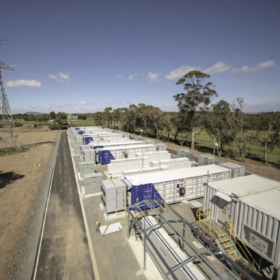
India set to add 30 GW of storage by 2027, outpacing demand forecast
India is projected to add 30 GW of new energy storage capacity by June 2027 through standalone and firm and dispatchable renewable energy (FDRE) projects, according to a recent report by SBI Capital Markets (SBICAPS). This could potentially push total capacity to 36 GW against 24 GW of estimated demand.
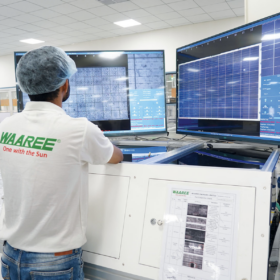
Waaree Energies opens 1.8 GW solar module plant in India
Waaree Energies has commenced production at its new 1.8 GW solar module factory in western India.

Novel MPPT method combines APO, model-predictive control
An international research team has tested a hybrid control technique combining adapted perturb and observe (APO) with model-predictive control to address complex partial shading in solar arrays. The method, validated through simulation and physical experiments, reportedly outperforms existing approaches.

Passive solar module cooling tech based on atmospheric water harvesting
Researchers in India have developed a cooling technology that uses calcium chloride for atmospheric water harvesting. The system reportedly improves PV module yields by up to 18%.

NHPC accepting bids to build 1.2 GW of solar in India
NHPC Ltd, on behalf of Bundelkhand Saur Urja Ltd (BSUL), has launched a tender to select developers to build 1.2 GW of solar power plants (four × 300 MW) in northern India.
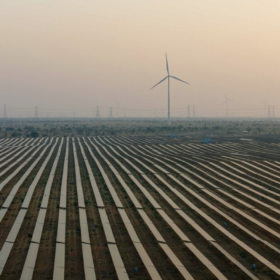
India could cut power costs to $50/MWh with solar-wind system by 2050
India could cut electricity costs to about $50/MWh by 2050 by transitioning to a fully wind- and solar-powered system with primarily day-night balancing, according to new modeling that includes generation, grid, and balancing costs – well below current fossil-based wholesale prices.

Using Sudoku to improve power yield in PV systems under partial shading
Indian researchers have developed a Sudoku-based technique to reduce power losses in PV systems operating under partial shading. They claim the method increases energy efficiency and revenue generation more than conventional reconfiguration techniques.
