
Sungrow secures 7.8 GWh battery storage deal from Saudi Arabia
China’s Sungrow has signed three landmark energy storage contracts with Saudi Arabia’s Algihaz Holding, amounting to the world’s largest grid-side storage order. Each project will have a capacity of 2.6 GWh, totaling 7.8 GWh.

JinkoSolar-led group to build 10 GW solar cell, module factory in Saudi Arabia
A JinkoSolar-led consortium has announced plans to construct a 10 GW solar cell and module factory in Saudi Arabia with PIF and Vision Industries Company.
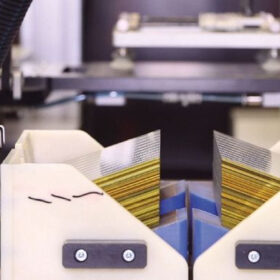
A gulf between PV ambition and testing facilities
Though it already hosts several of the world’s largest PV installations, the Middle East and North Africa (MENA) region’s solar industry is still young, with limited local infrastructure and expertise. Project developers are learning quickly that building PV in harsh desert environments requires a careful eye on quality. New testing laboratories are looking to meet demand.

EDF wins Israeli PV tender with bid of $0.019/kWh
EDF has won an Israeli solar tender with a bid of $0.019/kWh, securing a 100 MW project to sell energy at a record price of ILS 0.07 ($0.02)/kWh.
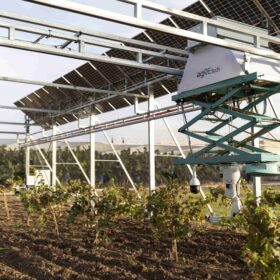
EDF invests in Israeli robotic agrivoltaics startup
AgRE.tech, which is developing a robotic operating system for existing photovoltaic infrastructure, has raised $2 million from EDF and Zemach Regional Industries. The company says it will soon set up commercial fields.

ACWA Power lands financing for Central Asia’s biggest battery storage project
The Saudi Arabian developer has reached financial close for the Tashkent Riverside project in Uzbekistan, which includes a 200 MW solar plant and a 500 MWh battery energy storage system (BESS).
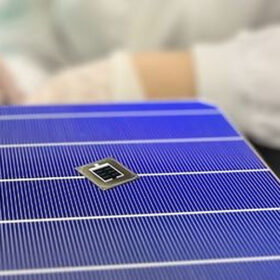
KAUST builds perovskite-perovskite-silicon tandem solar cell with 31.5% efficiency
The Saudi research institute said its new four-terminal tandem device has achieved the highest efficiency ever reported for perovskite-based 4-T and triple-junction tandem solar cells to date. The key feature of the cell is the hole transport layer of the top perovskite cell, which was engineered with self-assembled monolayers.
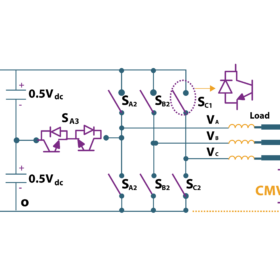
New pulse width modulation tech to reduce switching losses in three-phase inverters
Scientists in the Emirates have conceived a new space vector pulse width modulation method that reportedly reduces switching losses and increase efficiency in three-phase photovoltaic inverters. The proposed technique was found to have a higher efficiency, while providng lower common-mode voltage, leakage current and total harmonic distortion compared to traditional pulse width modulation approaches.

Israeli startup launches agrivoltaic pilot in desert with double-axis sun tracking
Agri-Light has launched its first pilot agrivoltaic project, using a two-axis solar installation on a rail system to move solar panels horizontally above a vineyard in the Negev Desert. The results are due this summer, and the company plans to build commercial projects in Israel and Spain next year.
DEWA unveils new method to measure current-voltage curves in PV systems
A group of scientists from the UAE-based energy utility has developed a new method to conduct I-V curve measurements without transporting the solar modules to laboratories for detailed analysis. The proposed Suns-Vmp approach reportedly offers a “very low” average root mean square error between the simulated and the real I-V curves.
