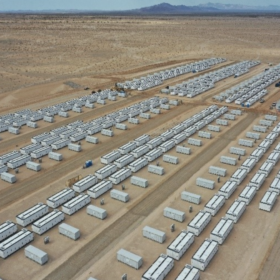
Canadian Solar consolidates US manufacturing assets
Canadian Solar says it will take direct control of its US solar and battery manufacturing assets through a new joint venture, shifting assets from its China-listed subsidiary and valuing the transaction at about $50 million.
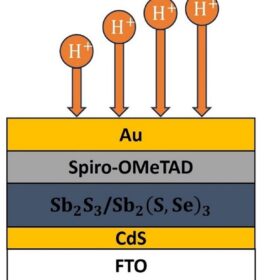
New research shows antimony chalcogenide solar cells are suitable for space use
Researchers in the US tested the degradation of antimony chalcogenide solar cells exposed to proton radiation. The result indicated a robust tolerance and potential for use in space.
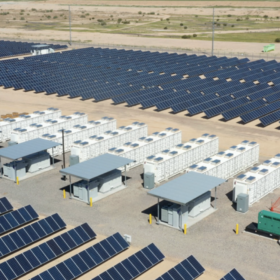
US battery capacity rises 59% with 14 GW added in 12 months, says EIA
The US Energy Information Administration (EIA) says that battery storage capacity grew by 13,809 MW in the past 12 months and is projected to expand by another 22,053 MW as solar continues to dominate new utility-scale additions.
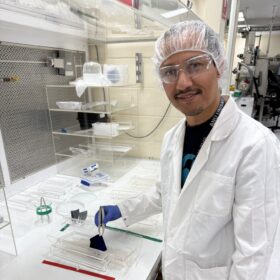
Antimony vs. phosphorous doping in solar wafer manufacturing
An international research team comprising scientists from Chinese module manufacturer Longi has investigated the resistivity distribution of antimony- and phosphorous-doped wafers used in solar cell manufacturing and have found that they offer comparable mechanical strenght. However, their work also showed that antimony-doped wafers have a more uniform resistivity, with a slight increase near the tail end.

Civ Robotics unveils AI-powered navigation tool to automate solar construction processes
Civ Robotics’ artificial intelligence (AI) powered navigation system tool is currently being tested at several large solar parks in the United States. The company says it eliminates the need for manual surveying with a sensor device fitted on a construction machine to guide operators to precisely place piles, pallets and PV modules.

U.S. extends solar manufacturing tariff exclusions
The U.S. Trade Representative has extended the exclusion of 178 items from the Section 301 import tariffs that were put in place by the prior administration in 2024. The still standing tariffs include a 50% increase on solar cells.

California lawmakers urge CPUC to enforce utility interconnection timelines
A coalition of 18 California legislators has formally urged the California Public Utilities Commission (CPUC) to enforce regulations under “Rule 21” regarding the interconnection of customer-sited solar and energy storage systems.

The Hydrogen Stream: EWE begins work on 320 MW hydrogen plant in Germany
EWE says construction has started on its 320 MW hydrogen plant in Germany as it seeks regulatory reforms, while Japan Suiso Energy and Kawasaki Heavy Industries have broken ground on a commercial-scale liquefied hydrogen terminal set to begin operations in 2030.
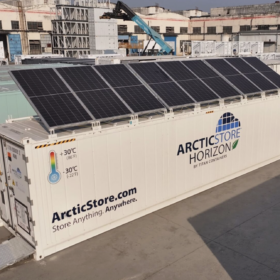
Denmark’s TITAN Containers adds solar to ArcticStore cold units
TITAN Containers says its new ArcticStore Horizon cold storage units integrate solar generation, advanced insulation and lower-GWP refrigerants to cut electricity use by 55% compared with conventional refrigerated containers.

Plenitude tests perovskite-silicon tandem solar modules in utility-scale installation pilot
The Italian renewable energy company said it will validate Swift Solar’s 28% efficiency perovskite-silicon tandem technology in a utility-scale project.
