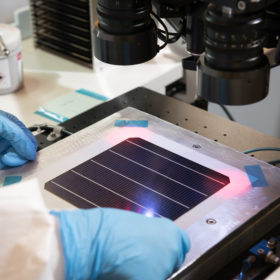
Oxford PV sets 28.6% efficiency record for full-size tandem cell
Oxford PV, a leading perovskite solar pv company with operations in England and Germany, achieved power conversion efficiency of 28.6% for a two-terminal perovskite-silicon tandem cell measuring 258.15 cm² cell: A world record for a device based on a ‘full size’ silicon wafer. The record was certified by Fraunhofer Institute for Solar Energy Systems (Fraunhofer ISE).
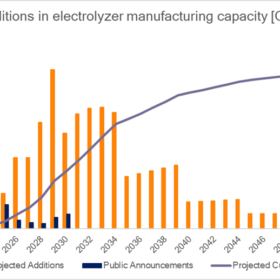
The Hydrogen Stream: Green hydrogen market could hit $850 billion in 2050
Research outfit Rethink Energy says the green hydrogen market could reach $850 billion in value by 2050.

Ideal unveils monobloc heat pump for residential applications
UK-based Ideal Heating has developed an air-source heat pump for the UK residential market. It is available in two versions with a heating output of 8.2 kW or 10.3 kW and uses R32 as the refrigerant. It says the heat pump can be paired with rooftop solar to maximize self-consumption.
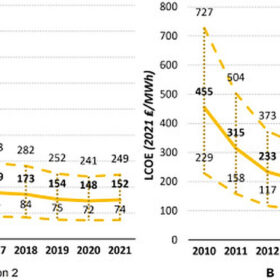
UK solar systems to be 50% cheaper by 2035, say UK researchers
University of Surrey researchers say that by 2035, the levelized cost of energy (LCOE) for small projects and utility-scale PV systems could decrease to GBP 149 ($187)/MWh and GBP 51/MWh, respectively.
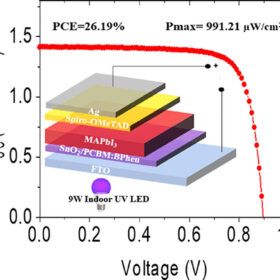
First attempt to build UV-stable perovskite solar cells that harvest energy from ‘black lights’
A UK research group has fabricated perovskite solar cells that can harvest energy from near-ultraviolet (UV-A) indoor LED lights. The devices achieved an efficiency of 26.19%, an open-circuit voltage of 0.90V, a short-circuit current of 1.42 mA/cm2, and a fill factor of 77.56%, resulting in a maximum power output of 991.21 μW/cm2.
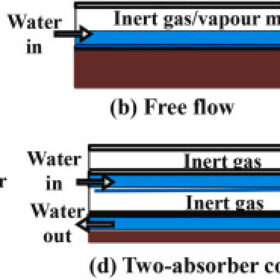
All photovoltaic-thermal system designs at a glance
An international research team has presented all possible system designs and applications for photovoltaic-thermal (PVT) technology. Their review includes conventional PV-T collectors, air-based systems, liquid-based installations, water-based collectors, refrigerant-based systems, heat-pipe-based technologies, dual air-water systems, building-integrated PVT arrays, and concentrated PVT collectors.

Weekend Read: New turf for thin films
Thin-film technologies have long promised to make a major impact on the solar industry but have largely been constrained to niche applications and research labs if they were not shredded by the market. After several false starts, current trade dynamics and promising research programs may help solar thin films find their place in the sun.

How green is the UK government?
With speculation rife UK prime minister Rishi Sunak could call a general election next year, Robert Cathcart, a blogger for English installer Solar Fast, takes a look at just how green the current government is.

Role of hydrogen, batteries in UK’s decarbonization efforts
Hydrogen and battery technologies are expected to play an increasingly vital role in the UK’s transition to net zero by 2050, but the varying time scales of their rollouts are driving uncertainty in predicted market share profiles over time, according to a new report.
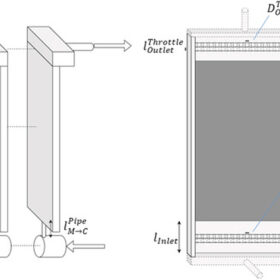
Soluble lead flow battery for PV applications
UK researchers have assessed the cost of a 24V soluble lead flow battery optimized for PV applications. They have found that a total component cost of GBP 50 ($62)/kWh could be achieved, which is half that of current nickel-manganese-cobalt (NMC) lithium-ion cells.
