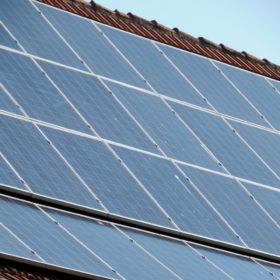
Germany tops global league table for renewable energy
A list compiled by a British price comparison website draws upon data from German company Statista which shows clean energy – including hydro – made up 12.74% of the nation’s power mix at the end of September.
China holds firm on strategy to build self-sufficient domestic polysilicon industry
The Chinese government will extend duties on U.S. and South Korean polysilicon for another five years from today despite committing to buy $200 billion more American goods and services in the trade deal signed on Wednesday. Poly manufacturer REC Silicon says it expects polysilicon to form part of that trade agreement.
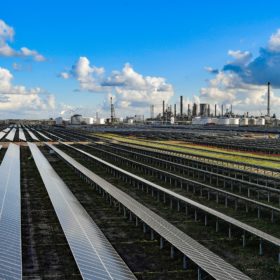
The weekend read: Your guide to market growth in 2020
Some 15 countries are likely to be able to lay claim to the status of being members of solar’s “gigawatt club” in 2019, according to conservative projections from BloombergNEF. Nonetheless, PV suppliers, developers and service providers are always on the lookout for new pockets of growth. To kick off 2020, pv magazine’s global team of correspondents and editors have highlighted 10 “fast-growing” solar markets to evaluate where the opportunities, and potential risks, lie.

BlackRock vows to exit coal as part of new climate-focused investment strategy
The U.S. asset management fund’s plan to cut future investment in coal is reportedly part of a climate-focused initiative to establish sustainability at the center of its business approach. The announcement comes weeks after the investor closed $1 billion of a record $2.5 billion fund focused on PV, wind and energy storage projects.

US government expects 24 GW of new solar this year
A Department of Energy agency expects 17.4 GW (DC) of utility scale solar power generation capacity plus 6.6 GW of small scale PV will be installed in 2020. That volume would be 60% higher than the record, set in 2016.
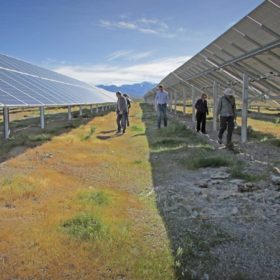
Desert solar farms can improve tortoise habitat
With openings in the fence and improved growth of plants vital for tortoise survival, solar farms in Nevada can provide better habitat than the surrounding desert. First Solar has found similar habitat gains in California.

More accusations of discrimination at Momentum Solar
A former employee is suing the U.S. company over allegations that she was terminated once she informed management about her high-risk pregnancy.
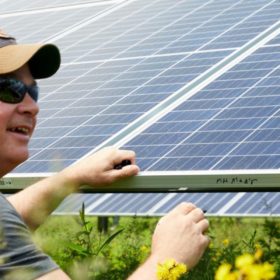
Solar industry snagged $27.8 billion in finance for company building, projects in 2019
Mercom Capital has released their annual report for 2019, describing the year as robust and showing company funding of $11.7 billion, up 20% over 2018, on top of announced project deals of $16.1 billion, up 14%.
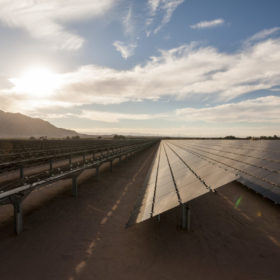
Why Europe and the US failed to capitalize on thin film solar
Is First Solar stalled in innovation and growth? Markus Beck, a thin-film solar expert and former chief technologist at First Solar, provides an industry perspective on the fate of thin-film PV in the United States.

Putting the strain into engineering a more stable perovskite
U.S. researchers claim to have improved the stability of one of the most promising halide perovskites – α-FAPbI3 – by squeezing the compound’s crystal lattices. The authors of the research prevented the crystal assuming an hexagonal shape at the room temperatures required for a PV device to operate properly.
