
European Consortium seeks to streamline agrivoltaics design
A European consortium including Germany’s Fraunhofer ISE is researching suitable crop and PV system combinations, conducting tests under Nordic conditions, and developing software to expedite adoption.
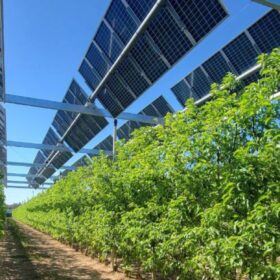
Catalonia sets guidelines for agrivoltaics
The government of the Spanish autonomous region of Catalonia has outlined new requirements to authorize agrivoltaic power generation on agricultural land.
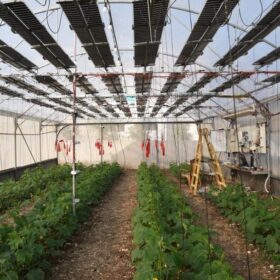
Agrivoltaics for cucumbers
Scientists in Israel have tested three different PV technologies to power a greenhouse hosting 400 cucumber seedlings. Their analysis has revealed that the PV module cover on the greenhouse’s roof has a “negligible” impact on crop yield, but they also noted that the greenhouse cover’s spectral transmittance and accumulated dust may negatively affect solar module performance.
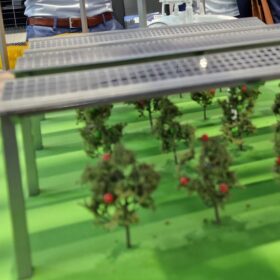
South Korea offers support for agrivoltaics
The South Korean government has announced a new package of measures to support agrivoltaic projects. It says that the agrivoltaics business should be a priority for agricultural companies.
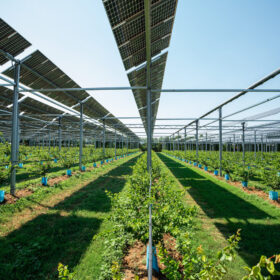
France issues new rules for agrivoltaics
The French government has published long-anticipated rules defining conditions for installing PV panels on agricultural areas, with consideration for the coverage rate and acceptable loss of agricultural yield.
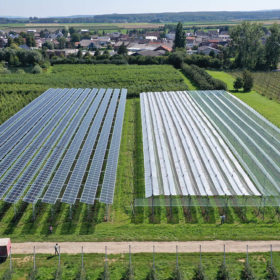
Vast majority of German farmers ready to embrace agrivoltaics
A new survey conducted by Germany’s Fraunhofer ISE showed that 72.4% of the country’s farmers are considering the deployment of an agrivoltaic project. Among the main factors behind this choice, the researchers identified the additional source of income coming from solar power generation and the perceived usefulness of the technology.
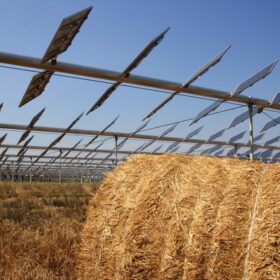
Wheat grows better in agrivoltaic facilities
New research from Italy shows lower wheat production under elevated agrivoltaic systems, but a simultaneous increase in nutritional value for livestock. pv magazine Italy spoke with the academics about their future research.
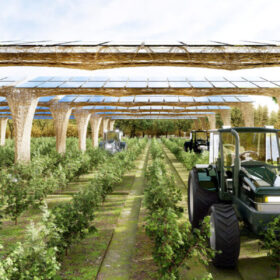
Agro Solar Europe unveils agrivoltaic mounting kit with organic materials
Agro Solar Europe has developed an agrivoltaic mounting structure made with organic materials, featuring a design that weighs 90% less than common steel structures. The Germany company has used raw materials such as flax, carbon, and wood fiber.
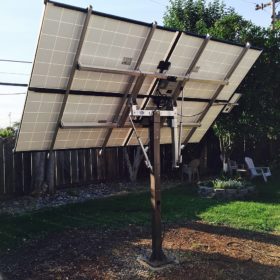
How to convert PV plants with dual-axis trackers into agrivoltaic facilities
A Spanish group of researchers has investigated how much agricultural production may be hosted by existing ground-mounted PV plants using dual-axis trackers. They outlined a new methodology that reportedly enables to quantify how much space around and beneath the panels can be uses for agricultural purposes.
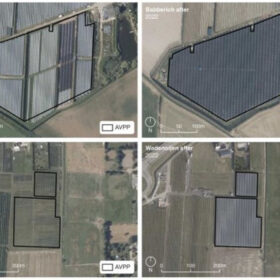
Landscape change indicators for agrivoltaics
Dutch scientists have developed new landscape change indicators (LCIs) for agrivoltaic projects. The novel methodology is meant to assist policymakers and project developers mitigate the visual and environmental impact of agrivoltaic facilities.
