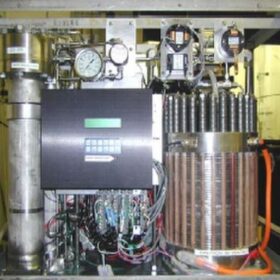
India launches tender for 1.5 GW of electrolyzer production
Solar Energy Corp. of India (SECI) has launched a tender to set up 1.5 GW of electrolyzer manufacturing capacity in India under the government’s incentives scheme.
India unveils incentives for green hydrogen, electrolyzer production
India’s Ministry of New and Renewable Energy (MNRE) has revealed the guidelines for its incentive schemes to promote the domestic production of green hydrogen and electrolyzers.
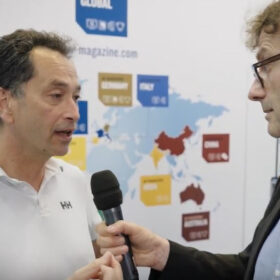
Intersolar 2023: ‘There’s a clear business case for green hydrogen in Europe’
Christian Pho Duc, CTO of Smartenergy, spoke with pv magazine at Intersolar 2023 about the recent EU decision to remove uncertainties over the production and use of green hydrogen, as the European Union has finally defined criteria for solar-powered electrolyzers. He stressed the importance of the new targets, under which the industry will have to buy 42% of its hydrogen from clean sources by 2030.
The Hydrogen Stream: Northern Europe can produce green hydrogen
Finnish researchers have said in a new report that northern European countries could produce cheap hydrogen domestically, while TotalEnergies, Schneider Electric and other companies signed new hydrogen project deals.
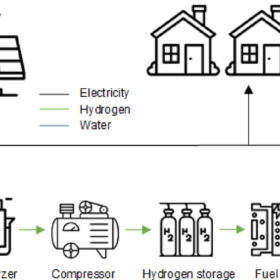
Novel approach to PV-battery-electrolyzer-fuel cell systems
TU Delft scientists have proposed a new methodology for off-grid PV-battery-electrolyzer-fuel cell systems in remote areas.
India’s BHEL to make electrolyzers
Bharat Heavy Electricals says it is seeking a business consultant to explore opportunities in electrolyzer production and the green hydrogen value chain.
Only5mins! – Lower electrolyzer costs crucial for green hydrogen deployment
Low electrolyzer costs, low capex, a low levelized cost of energy, and a decent capacity factor are key to developing viable green hydrogen projects. George Touloupas, senior director of technology for Clean Energy Associates, tells pv magazine about the main challenges and the current price trajectory for green hydrogen tech.
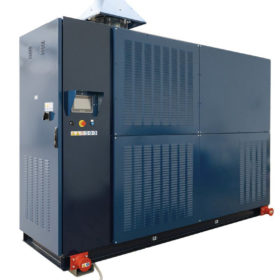
Weekend Read: All of the above
Competition is intensifying in the electrolyzer space. With the International Energy Agency (IEA) expecting 380 GW of hydrogen production capacity in 2030, four different technologies will likely become prominent as demand spikes. We take a look at the market.
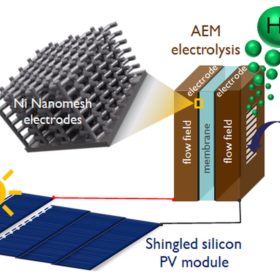
Photovoltaic electolyzer with shingled solar panels, anion exchange membrane
Scientists in Belgium have designed a solar-powered electrolyzer that uses standard-sized, large area shingled silicon PV for water splitting. The system is reportedly able to achieve solar-to-hydrogen efficiency of 10% at electrolyzer current densities of approximately 60 mA cm−2.
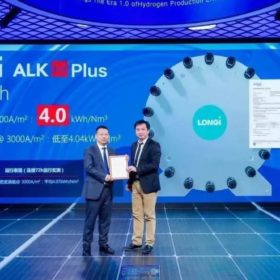
Longi releases new alkaline electrolyzer
China’s Longi claims that its new ALK Hi1 electrolyzer can produce hydrogen with an energy content of 4.3 kWh per normal cubic meter. It says the levelized cost of hydrogen could be up to 2.2% lower than other electrolyzers on the market.
