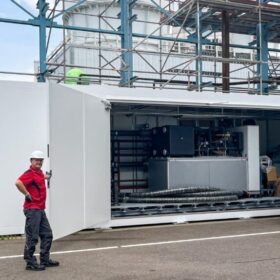
Fraunhofer IEG opens testing site for MW-sized heat pumps
The Fraunhofer Institute for Energy Infrastructures and Geothermal Energy (Fraunhofer IEG) says it plans to open two new test benches for large heat pumps. Manufacturers, developers and project planners will have access to the test benches, in order to bring new systems to market maturity.

Australian government approves nation’s largest battery
Australia’s federal government has granted approval for a 1.2 GW/2.4 GWh battery system – one of the world’s largest – at a site northwest of Melbourne. The project is owned by Equis Development, with support from the Abu Dhabi Investment Authority and the Ontario Teachers Pension Plan Board.
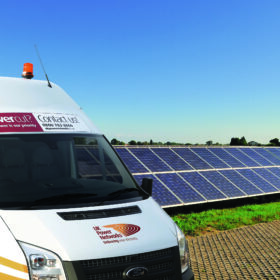
UK Power Networks kicks off 850 MW flexible electricity tender
The UK’s largest transmission system operator, UK Power Networks, recently launched an 850 MW flexible electricity tender. The company’s Distribution System Operator’s head of flexibility markets, Alex Howard, tells pv magazine that the tender will manage demand growth and help get more renewable projects in a ‘big queue’ connected to the network.

Hybrid photovoltaic-tidal energy system for island resorts
Scientists in India have proposed to combine solar PV with tidal energy and storage to cover the entire electricity demand of island resorts. They found the system could help to reduce energy costs for residents and businesses.
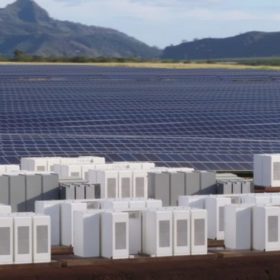
India’s NHPC tenders 1.5 GW of renewables storage
NHPC has launched a tender to select developers for 1.5 GW of firm, dispatchable power from renewable energy projects with storage systems across India. Developers can submit online bids until Nov. 13.

European electricity prices were down in first week of October
In the first week of October, average prices in most European electricity markets were below €85/MWh and lower than the previous week – but in some hours and markets, prices exceeded €200/MWh.
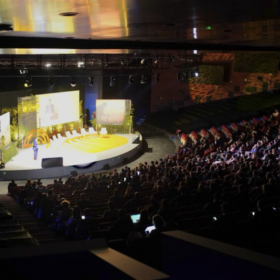
Key takeaways from Spain’s Foro Solar
The latest edition of Foro Solar, hosted by the Spanish solar association, UNEF, showcased Spain’s advancing market growth, but also highlighted several challenges the country may encounter in the future.
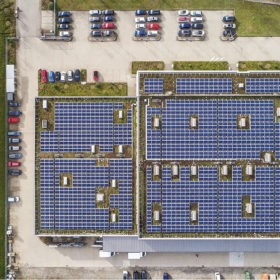
EU Council adopts new renewable energy directive
The European Council today announced policies aimed at targeting sectors – such as transport, industry and buildings – that are ‘slow’ to adopting the recently cemented 45% by 2030 renewable energy goal.
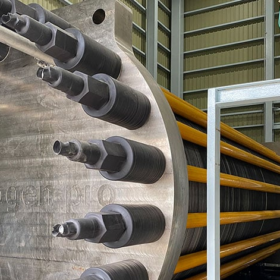
Mitsubishi testing 5.5 MW pressurized alkaline electrolyzers in Japan, Norway
Mitsubishi has conducted short-term validation tests of its 5.5 MW pressurized alkaline electrolyzers in Norway and long-term validation tests in Japan. It plans to incorporate the design of these two single-stack pressurized alkaline electrolyzers into a US project.
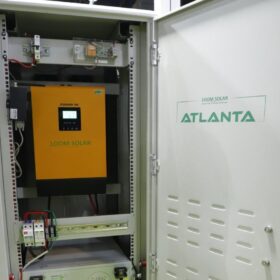
Loom Solar unveils 5 kWh/10 kWh storage system
India’s Loom Solar has developed an Internet of Things (IoT)-based, all-in-one energy storage solution for homes and businesses, featuring lithium iron phosphate (LFP) batteries.
