
Dracula Technologies builds organic PV module factory in France
Dracula Technologies has built an organic photovoltaic (OPV) module factory in France to make OPV devices with digital printing technology for connected objects. The facility can produce up to 150 million cm² of OPV modules per year, with the first shipments scheduled to start in 2024.
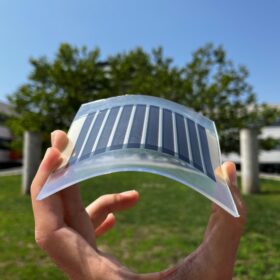
European research group creates injection molding plastic solar cells
A French-Spanish research team developed organic photovoltaic modules embedded into plastic parts through high throughput injection molding. The researchers injected thermoplastic polyurethane in the modules and found it enhances their mechanical stability while keeping a high flexibility.
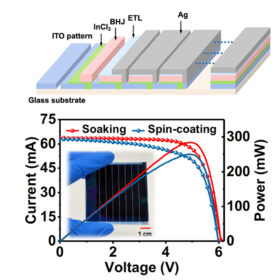
Organic cell based on HTL made of indium chloride layer achieves 18.92% efficiency
Scientists in China have fabricated an organic solar cell based on an indium tin oxide hole transport layer modified with an interfacial layer made of recycled indium chloride (InCl3).

Fraunhofer ISE unveils 15.8%-efficient organic solar cell
Germany’s Fraunhofer ISE has achieved a world record efficiency for organic cells at the lab level. It now aims to bring the PV technology to market maturity.

Binary organic solar cell achieves 19,31% efficiency
Hong Kong Polytechnic University researchers have developed a binary organic solar cell (OSC) with a record power conversion efficiency of 19.31%. They invented a non-monotonic intermediate state manipulation strategy to lower the non-radiative recombination loss and boost efficiency.

Weekend Read: New turf for thin films
Thin-film technologies have long promised to make a major impact on the solar industry but have largely been constrained to niche applications and research labs if they were not shredded by the market. After several false starts, current trade dynamics and promising research programs may help solar thin films find their place in the sun.
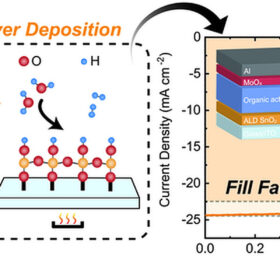
Tin oxide-based organic solar cell hits 17.26% efficiency, 79% fill factor
Dutch scientists have used atomic layer deposition to build an organic solar cell with a tin oxide electron transport layer. This improved electron mobility and transparency, resulting in a record fill factor.
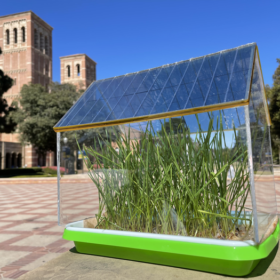
Semi-transparent organic photovoltaics for greenhouse applications
Scientists from the University of California, Los Angeles (UCLA), have used an antioxidant known as L-glutathione as an interlayer in an organic PV cell to prevent other materials from oxidizing. The cell has an efficiency of 13.5% and an average visible transmittance of 21.5%. The researchers said it is suitable for applications in solar greenhouses.
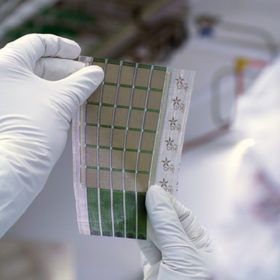
MIT scientists produce new organic photovoltaic fabrics
US researchers have developed a thin-film organic solar module on a vapor-deposited releasable substrate made of parylene. The device could be used as a wearable fabric, or to bring solar generation to remote locations.

Transparent organic PV materials for solar window applications
US scientists have built photovoltaic materials with two top layers made of phthalocyanine and heptamethine. They tested the new tech across four different climate areas in the United States.
