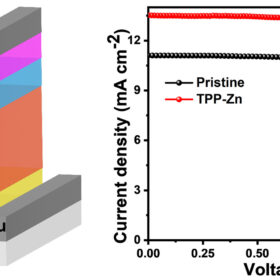
Inorganic perovskite solar cell based on tetraphenyl-porphine zinc interlayer achieves 82% fill factor
An international research team has proposed a perovskite solar cell architecture incorporating a thin tetraphenyl-porphine zinc interfacial layer to enhance surface potential, passivate defect states, and improve charge transport. The strategy leads to improved device efficiency and operational stability, enabling power conversion efficiencies exceeding 13%.

Australian researchers develop vapour-based manufacturing process for lead-free perovskite solar
Researchers at the University of Queensland have developed a scalable, lead-free perovskite solar cell manufacturing process that achieves record indoor-light efficiency while avoiding toxic materials and enabling flexible consumer electronics applications.

Scientists discover why lead-halide solar perovskites work efficiently despite being structurally ‘messy’
Researchers in Austria found that unusually high photovoltaic efficiency in lead-halide perovskites can be explained by internal electric fields generated at strain-induced domain walls, which separate charge carriers and enable long-range transport. Their experiments indicated that these effects arise from mesoscopic structural inhomogeneities rather than a uniform crystal structure, providing a general mechanism for charge separation in these materials.

GCL Optoelectronic targets 2026 IPO, US plant, space solar rollout
GCL Technology says its GCL Optoelectronic subsidiary plans a Hong Kong initial public offering (IPO) in 2026, alongside a potential 500 MW factory in the United States and a roadmap for space-based solar.

New Time targets large-scale perovskite production in Italy
New Time has outlined a four-year roadmap to industrialize perovskite solar cells in Italy, with pilot production planned within three years and full-scale output to follow.

Japan publishes new guidelines for flexible solar cell installations
Japan’s New Energy and Industrial Technology Development Organization (NEDO) says its new design and construction guidelines for flexible PV and perovskite solar installations will help ensure the safety and reliability of systems deployed on low-load rooftops and wall surfaces where conventional panels cannot be installed.

Graphene could improve durability of perovskite solar cells
Nearly 20 years after the first perovskite solar cell was developed, its efficiency and durability are drawing interest from industries worldwide. The defense sector is among the most active, as rising geopolitical tensions drive record government spending to protect critical systems from disruption and attack.
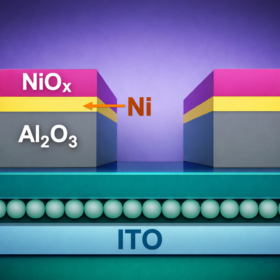
Korean researchers build back-contact perovskite solar cells with lower recombination losses
The research team developed the perovskite solar cell with a spin-coated bilayer tin oxide electron transport layer that boosts charge extraction, achieving a 4.52% efficiency and improved stability.
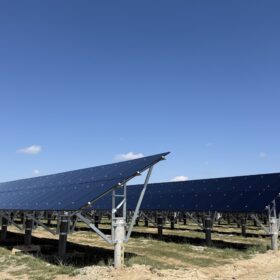
Why AI matters for scaling perovskite solar modules
pv magazine spoke with Fan Bin, founder of GCL Optoelectronics, about how high-throughput experimentation and AI-driven optimization are accelerating perovskite development, and why stability, and not efficiency, remains the key challenge on the path to mass production
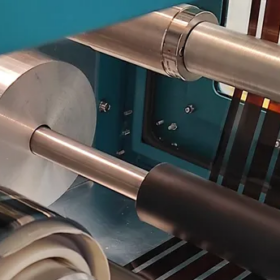
Power Roll testing new metrology for perovskite solar
The UK-based perovskite solar PV specialist has announced a new metrology research project with Swansea University and a new development agreement with Renolit, a German plastic films, sheets and polymer solutions company.
