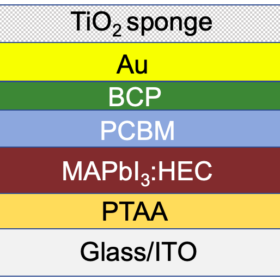
Semitransparent perovskite solar cell with 11.6% efficiency
Italian scientists have used a titanium oxide sponge to successfully prevent lead leakage in a semitransparent solar cell. The device has demonstrated comparable efficiency to semi-transparent perovskite devices and has an average visible transmittance (AVT) of 31.4%.
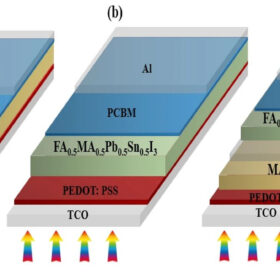
Novel design for inverted all-perovskite bilayer solar cells with 24.83% efficiency
An international research team has crafted an innovative solar cell design. By employing a top absorber consisting of methylammonium lead iodide (MAPbI3), a lead-halide perovskite, and a bottom absorber composed of FA0.5MA0.5Pb0.5Sn0.5I3, a perovskite material, the cell maximizes light absorption across a broad spectrum.
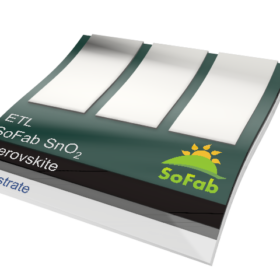
US startup develops flexible inverted perovskite solar cell with 16.1% efficiency
Scientists from the US National Renewable Energy Laboratory (NREL) and the University of Louisville have developed a revolutionary solar cell using yttrium-doped tin oxide nanoparticles. The innovation improves charge extraction and overall cell performance.
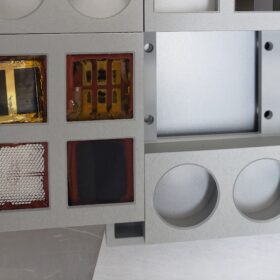
NASA makes unusual discovery while testing perovskite solar cells in space
NASA has discovered that perovskite solar cells tested in space exhibit less degradation than reference devices tested on Earth. The agency acknowledged that it is uncertain about the specific factors in the space environment that contributed to the superior performance of the perovskite absorber film.
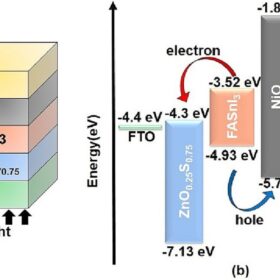
Indian researchers design lead-free perovskite PV cell with 31.57% efficiency
Researchers at India’s National Institute of Technology (NIT) Silchar, Assam, have designed a formamidinium tin iodide (FASnI3) active layer-based perovskite solar cell. It could potentially achieve a power conversion efficiency of 31.57%, while also scoring well on other performance parameters.
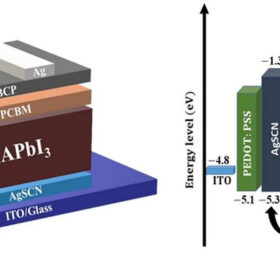
Inverted perovskite PV cell with silver thiocyanate HTL hits 16.66% efficiency
Egyptian researchers have developed a novel hole transport layer (HTL) for inverted perovskite solar cells using silver thiocyanate instead of the commonly used PEDOT:PSS and copper thiocyanate. The new HTL material demonstrated exceptional efficiency and stability in the constructed cell.
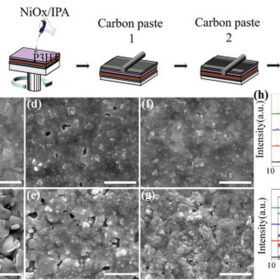
Carbon electrode perovskite solar cell with 20.8% efficiency
Researchers in China have built one of the most efficient carbon electrode perovskite solar cells ever reported to date. The device uses an organic/inorganic planar hole transport layer structure that purportedly has superior electrical contact.
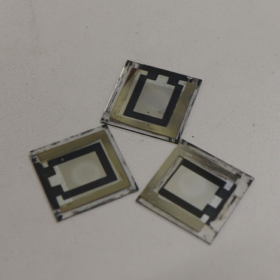
Inverted perovskite solar cell achieves 24.8% efficiency via new additive
The additive consists of a molecule known as 4-guanidinobenzoic acid hydrochloride (GBAC), which is a raw material and intermediate commonly utilized in organic synthesis, pharmaceuticals, agrochemicals and dyestuff fields. The solar cell has a p–i–n structure and, thanks to the new additive, showed considerably reduced defect density on the perovskite film, which in turn results in reduced non-radiative recombinations.
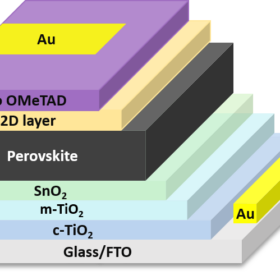
3D/2D perovskite solar cell treated with substituted PEAI hits 23.08% efficiency
An international research team has fabricated a quasi-2D perovskite solar cell with a special kind of phenethylammonium iodide (PEAI) salt to enhance hole extraction. The result is a 23.08%-efficient device that is also able to retain 95% of its initial efficiency after 900 hours.
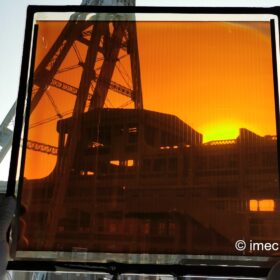
Imec unveils 781 cm2 bifacial perovskite solar panel with 11.9% efficiency
Scientists in Belgium have developed perovskite solar panels with a thermally stable device stack. The encapsulated bifacial panels they created with this configuration were able to retain around 92% of their initial efficiency after 1,000 hours.
