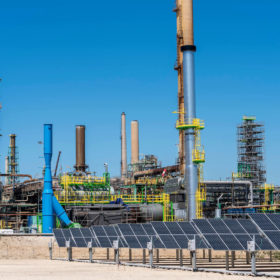
Engie, Total plan 40 MW solar-powered electrolyzer
The two French energy giants have announced a partnership agreement to develop, build and operate the Masshylia project – a 40 MW electrolyzer coupled with solar parks at the Total biorefinery in Châteauneuf-les-Martigues, in the southern region of Provence-Alpes-Côte d´Azur.
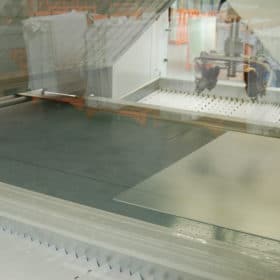
Anti-soiling nanocoating for large-scale PV
Dutch company Rads Global Business has developed an anti-soiling coating for solar PV modules that is claimed to reduce cleaning cost by around 60%. The anti-reflective and anti-corrosive coating is also said to mitigate potential-induced degradation (PID).

Spanish PV struggling with snowfalls caused by Storm Filomena
While Spain is struggling with the largest snowfall since 1971, pv magazine editor Alejandro Diego Rosell has asked two Spanish experts what the consequences of the massive snow loads produced by Storm Filomena will be on solar installations. According to them, some PV systems may stop working completely and component failures may not be excluded.
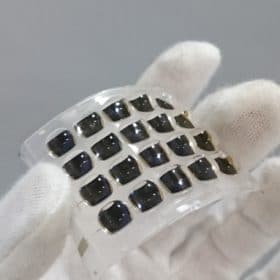
Stretchable CPV module with 15.4% efficiency
Japanese scientists have fabricated a prototype CPV panel that could be applied on spherical surfaces with a curvature radius of 100 mm, and under outdoor one-sun irradiation. The module is based on a silicone concentrator lens, a thermoplastic polyurethane sheet, and a rigid III–V triple-junction solar cell.
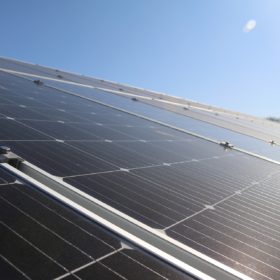
India added 5.2 GW of solar in April-November period
India’s PV capacity additions fell 38% year on year in the first eight months of fiscal 2020-21 (to the end of November), as pandemic-driven disruptions constrained new project development.

Engie, Neoen plan 1 GW solar-plus-storage project in France
The two French companies have announced Horizeo, a massive project that includes a solar plant, battery storage, a green hydrogen production unit, a data center, and an agrivoltaic facility. The huge project is scheduled for completion in 2026.
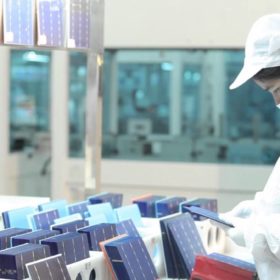
Chinese PV Industry Brief: Jinko begins work on 20 GW cell factory
The solar cell manufacturing facility, located in China’s Yunnan Province, is expected to raise Jinko’s cell capacity to 30 GW by the end of 2021.
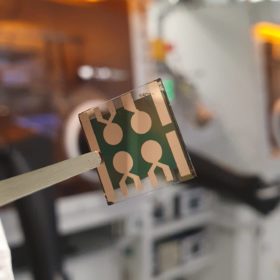
Inverted perovskite solar cell with 21.1% efficiency and high moisture resistance
Australian scientists have built a perovskite solar cell based on 2D and 3D salts. By adding a fluorinated lead salt in the processing solution – normally used to form 3D methylammonium lead iodide – they were able to achieve a 21.1% efficiency, an open-circuit voltage of 1.12 V, a short-circuit current of 22.4 mA/cm2, and a fill factor of 84%.

JinkoSolar announces 23.01% efficiency for n-type monocrystalline panel
The PV module relies on Jinko’s TOPCon mono cell technology, for which a record efficiency of 24.9% was announced last week. TÜV Rheinland has confirmed the result.

South Korea may tender 4 GW of solar PV this year
The Korea Energy Agency (KEA) will likely launch two 2 GW tenders in April and October. These will include the procurement of large-scale solar PV parks for the first time.
