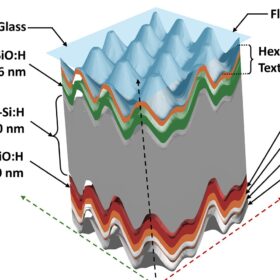
Honeycomb-shaped micro-structures enhance thin film silicon solar cells
TU Delft researchers developed a novel hexagonal microtextured glass that enhances light scattering up to 50%, improving optical performance in thin-film silicon solar cells. The technology shows promise for multijunction, flexible, and low-power solar applications.
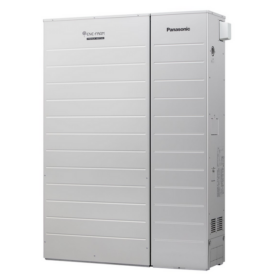
Panasonic debuts fuel cell cogeneration system for PV‑integrated homes
Panasonic has launched a new home fuel cell system for detached houses, designed to boost solar self-consumption through HEMS‑based smart scheduling. The unit generates electricity and heat from gas, supports demand response, and can supply emergency power during outages.

German consortium launches web guide for BIPV planning
Germany’s SolarEnvelopeCenter project has launched a web-based planning guide for building-integrated photovoltaics (BIPV), offering standardized design solutions for roofs and facades that comply with building codes and industry standards.

China wafer prices fall for fourth week as discounting deepens under inventory pressure
In a new weekly update for pv magazine, OPIS, a Dow Jones company, provides a quick look at the main price trends in the global PV industry.
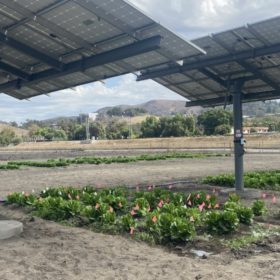
Agrivoltaics for regenerative agriculture
U.S. researchers are testing regenerative agrivoltaics at a farm in Southern California, combining solar panels with soil-restoring practices like composting, cover cropping, and no-till farming to enhance crop yields, soil health, and water-use efficiency. The pilot evaluates technical, ecological, and economic viability while exploring how this land-sharing approach can optimize food and energy production, reduce irrigation needs, and inform larger-scale deployment and policy frameworks.

How to detect PV system underperformance using only AC-side inverter data
An Australian research team has developed a five-step, rule-based method that detects and classifies underperformance in PV systems using only AC-side inverter data. Validated across more than 1,000 systems, the approach offers a low-cost, low-intervention solution for improving reliability, fault response, and PV system performance.

New single-diode model tackles recombination losses in solar cells
UNSW researchers have developed an intrinsic-adjusted single-diode model that explicitly accounts for radiative and Auger recombination, improving I–V curve accuracy and reducing root mean square error by up to a factor of three. The model is claimed to better predict performance near open-circuit voltage and maximum power point.

Dominican Republic updates net metering rules for rooftop solar
The Dominican Republic has approved new regulations for rooftop solar, shortening approval times, digitizing processes, removing penetration caps, and increasing annual compensation for surplus energy to 100%.

Anti-glare film enables PV system at Brussels Airport
Warehouses De Pauw (WDP) has installed an 8.5 MW solar system at a warehouse near Brussels-Charleroi Airport, equipping roughly 40% of modules with Phytonics anti-glare film to prevent air traffic disruption while maintaining near-full energy output.

The effects of solar module elevation on ground-mounted PV
Scientists in Hungary found that ground-mounted PV modules at an intermediate elevation of 1.1 m achieve the highest efficiency and power output due to improved airflow and reduced cell temperature. Their study also estimated a levelized cost of electricity of $0.0843/kWh and 577.78 kg CO₂ mitigation over 25 years, while noting results are specific to concrete surfaces.
